What Size File Do You Need for a Chainsaw?
Match the file diameter to your chain's pitch and cutter design: 5/32 in files suit many 1/4 in and 3/8 in low-profile chains, 3/16 in files suit many .325 in chains, and 7/32 in files suit many 3/8 in and .404 in chains. Use the chain maker's file chart when the pitch alone does not settle it.
On this page (12 sections)
- What size file do I need for my chainsaw?
- How does chain pitch determine file size?
- What file size does a 3/8-inch chain use?
- Which file fits a .325-inch chainsaw chain?
- When should you choose a 5/32-inch file?
- What is the difference between a round and flat file?
- Which file kit is best for a complete field setup?
- How do you use the correct file on a chainsaw chain?
- How can you tell that the file size is wrong?
- How do bar length and handle style affect file choice?
- Which chainsaw file should you choose?
- What size file do I need for my chainsaw in the end?
The file you need depends on the chain, not the chainsaw's engine size. Start with the chain pitch and cutter style: 5/32 in, 3/16 in and 7/32 in are the main sizes in this guide, but the correct choice belongs to the chain.
A round file sharpens the top plate and side plate of each cutter. A flat file handles the depth gauges, which control how deeply each cutter enters the wood.
Read the chain markings or measure the chain before buying a file. If you are still identifying the chain, our guide to how to find your chainsaw chain size explains the labels and measurements that matter.
What size file do I need for my chainsaw?
Use the file diameter recommended for the exact chain model. The common starting points are 5/32 in for 1/4 in and 3/8 in low-profile chains, 3/16 in for many .325 in chains, and 7/32 in for many standard 3/8 in chains.
| Chain pattern | Common round file starting point | Main caution |
|---|---|---|
| 1/4 in | 5/32 in | Confirm the chain maker's chart |
| 3/8 in low profile | 5/32 in | Do not confuse it with standard 3/8 in |
| .325 in | 3/16 in | Cutter design can change the recommendation |
| 3/8 in standard | 7/32 in | Some chain families use another size |
| .404 in | 7/32 in or larger | Use the exact chain chart |
These are common matches, not a permission to guess. Two chains with similar pitch labels can use different file diameters because the cutter shape, drive-link design and intended saw size differ.
The file should sit high enough to form the cutter's top plate angle while still contacting the side plate. If the file is too small, it can lower the top edge and leave the cutter with a poor shape.
If it is too large, it can remove too much from the top.
Choose the chain-specific file size whenever the chain maker gives one.
How does chain pitch determine file size?
Chain pitch narrows the choice, but it does not identify the file by itself. Pitch is the average distance between adjacent rivets, while file size depends on the cutter geometry built around that pitch.
Common pitch labels include 1/4 in, 3/8 in low profile, .325 in, 3/8 in and .404 in. The pitch may be stamped on the guide bar, chain package or replacement-chain information.
It can also be measured from the distance between rivets, though a printed chain code is easier to use when available.
The term “3/8 in” creates the biggest trap. A standard 3/8 in chain and a 3/8 in low-profile chain do not normally use the same round file.
The low-profile version is smaller and commonly pairs with a 5/32 in file, while standard 3/8 in commonly pairs with a 7/32 in file.
Your chainsaw bar length guide can help separate bar measurements from chain measurements. Bar length tells you how long the cutting guide is, but it does not tell you which file diameter belongs to the chain.
Treat pitch as the first filter, not the final answer.
What file size does a 3/8-inch chain use?
A standard 3/8 in chain commonly uses a 7/32 in round file, while a 3/8 in low-profile chain commonly uses a 5/32 in round file. Identify the chain type before choosing between these two sizes.
Standard 3/8 in chain is common on larger saws used for heavier cutting. Its cutters and drive links are built on a larger scale than those on a low-profile chain.
Low-profile 3/8 in chain is used on many smaller saws and compact cutting systems.
Look at the chain code, the saw documentation or the replacement-chain package. The bar may also carry a chain pitch and gauge marking, but those markings can be hard to read after years of use.
A file that matches standard 3/8 in can be too large for a low-profile chain. A file intended for low-profile chain can be too small for standard 3/8 in and produce a poor cutter shape.
A useful 3/8-inch file choice
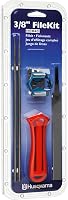
This Husqvarna kit is built around 3/8 in pitch H chains, including the H42, H45, H46, H47, H47S, H48, H48S, H50, H51, H54, H80 and H81 chain families. Its combination guide includes a 2-in-1 roller file guide and depth gauge, while the handle gives you a controlled grip on the flat and round files.
Pick the 7/32 in file for standard 3/8 in chain only when the chain family matches the kit's intended use.
Which file fits a .325-inch chainsaw chain?
Many .325 in chains use a 3/16 in round file, but the exact chain family still controls the choice. Use 3/16 in as the starting point for a .325 in chain, then match the file to the chain's sharpening instructions.
The .325 in pitch sits between smaller low-profile chains and larger standard 3/8 in chains. It is common on saws that need a balance between cutting speed, tooth size and manageable chain movement.
A correct file should contact the cutter at the intended height and leave the top plate with a consistent angle. Keep the file level from side to side as you work.
A file guide helps hold the angle, especially when you are still building a steady filing motion.
Do not select a file because it came with a similar-looking saw. The same bar length can be paired with different chain pitches, gauges and cutter profiles.
A chain that has been sharpened many times also needs attention to cutter length. The file size does not replace the need to keep the cutters even and the depth gauges in proportion.
For a .325 in chain, start with 3/16 in and let the chain's exact code settle the final choice.
When should you choose a 5/32-inch file?
Choose a 5/32 in file for many 1/4 in and 3/8 in low-profile chains. This is the small-file option in the common chain-size range, so use it when the chain is built for that diameter rather than simply because the saw is compact.
Small chains need a file that fits the cutter without removing too much material. A larger file can ride too high over the cutter and fail to shape the cutting edge correctly.
A file that is too small can cut into the wrong area and change the top-plate profile.
Small electric, battery and light-duty gas saws often use compact chains, but motor type does not identify the file. A battery saw can use a chain that needs a larger file, and a gas saw can use a smaller low-profile chain.
Measure the chain and read its code before choosing. If you are replacing the chain, keep the old chain package or write down its pitch and gauge so the next sharpening decision is easier.
A portable alternative for several file sizes
The Sharp Pebble kit includes four sharpening wheels: 5/32 in, 3/16 in and two 7/32 in wheels. Its angle guide attachment is designed to keep the sharpening angle consistent, and its cordless format suits work away from a bench.
The tool uses a clamp, a selected wheel and an adjusted angle before you move through the chain teeth. That makes it useful when your chains include more than one common file size, but you still need to select the wheel that matches the chain.
Choose 5/32 in for a confirmed small chain, not for every compact chainsaw.
What is the difference between a round and flat file?
A round file sharpens the cutter, while a flat file lowers the depth gauge. You need the round file for the cutting edge and the flat file for the small metal projection that sets the cutter's bite.
Each cutter has a top plate and side plate. The round file removes metal from those edges and restores the shape that cuts wood.
The file must remain at the correct height and angle as you move across the chain.
The depth gauge sits ahead of the cutter and controls how far the cutter can enter the wood. As you sharpen the cutter repeatedly, its top edge becomes lower.
The depth gauge must be adjusted to keep the difference between the cutter and gauge within the chain maker's intended range.
A flat file is used with a depth-gauge guide so you do not remove too much material. Filing the depth gauges by eye can change how aggressively the chain feeds and how smoothly the saw cuts.
The round file and flat file have different jobs, even when they are sold in one kit. Do not substitute one for the other.
Sharpen cutters with the correct round file, then manage depth gauges with a flat file and guide.
Which file kit is best for a complete field setup?
A complete field kit should cover the needed round file, a flat file, a file handle and a way to hold or guide the chain. The Oregon chain sharpening kit with hard case is the most complete option here for someone who wants several common file sizes and extra maintenance tools together.
The Oregon kit includes two 5/32 in round files, two 3/16 in round files and two 7/32 in round files. It also includes a 6 in flat file, file guides, universal handles, a depth gauge tool, a stump vise, a chainsaw wrench, a mini screwdriver, a chain and bar measuring tool and a 5-1/2 in felling wedge.
The fitted case keeps those pieces in separate compartments. The stump vise gives you a way to secure the saw at a stump while working outdoors, and the measuring tool helps identify chain and bar details before filing.
The trade-off is size and weight compared with a single round file and handle. It weighs 1 lb and takes more storage space than a minimal kit.
Pick Oregon when you maintain different chains or want a field kit with its own holding and measuring tools.
How do you use the correct file on a chainsaw chain?
Secure the saw, select the matching file and keep the filing motion consistent. The correct file only works well when the chain is stable and every cutter receives the same basic treatment.
Remove the battery or disconnect the spark plug wire before working around the chain. Engage the chain brake when appropriate, then secure the bar in a vise or use a stump vise.
Wear suitable eye protection and gloves that allow controlled handling of the file.
Start with the shortest cutter if the chain has uneven teeth. Use it as the reference for the other cutters.
Place the round file in the cutter's gullet and keep the file at the guide's intended height.
Push the file through the cutter in a controlled direction. Lift it on the return rather than scraping it backward through the tooth.
Count similar strokes on each cutter, then change sides and repeat for the opposite cutting direction.
After the cutters are even, use the flat file with a depth-gauge guide. Remove only the amount needed to restore the intended relationship between the gauge and cutter.
Keep the file size, filing height and number of strokes consistent across the chain.
How can you tell that the file size is wrong?
A wrong file size often leaves an uneven cutter shape, a poor top-plate edge or a file that sits too high or low in the gullet. Stop when the file does not contact the cutter in the intended position instead of forcing the sharpening motion.
A file that is too large can ride over the cutter and touch the top plate incorrectly. The cutting edge may look rounded rather than crisp.
A file that is too small can sit deep in the gullet and remove metal from the lower part of the cutter.
Compare the sharpened tooth with an unfiled cutter if you have one. Look for a clean top plate, a clear side-plate edge and similar cutter lengths around the chain.
Uneven teeth can make the saw pull to one side or cut a crooked path.
Metal dust and a smooth file surface also point to a file that is no longer cutting well. A file should remove metal with moderate pressure.
Heavy force can make you lose the intended angle.
If the chain has severe damage, broken cutters or a deeply worn shape, filing may not restore it to a safe working condition. Replace the chain when its condition calls for replacement.
If the file sits wrong or the cutter shape looks wrong, reassess the chain code before taking more metal.
How do bar length and handle style affect file choice?
Bar length and handle style affect how you use the saw, but neither one selects the file diameter. The chain pitch, cutter profile and chain code remain the deciding information.
A long bar does not automatically use a larger file. A short bar does not automatically use a smaller one.
The chain installed on the bar determines the file, so identify the chain separately from the bar measurement.
Handle style also changes the saw's balance and intended handling. Our guide to top-handle vs rear-handle chainsaws explains that distinction, but the same filing rule applies to both styles.
Top-handle saws may use compact chains, while rear-handle saws can use several chain sizes depending on the model and bar setup. Electric and battery saws also span more than one chain type.
Before sharpening, record the pitch, gauge and cutter style. Then select the round file, flat file and guide that match those details.
This short checklist prevents a familiar saw label from replacing the information that actually controls sharpening.
Choose the file from the chain, never from bar length, motor type or handle style alone.
Which chainsaw file should you choose?
Choose the Husqvarna kit for a confirmed 3/8 in H-chain setup, Oregon for several chain sizes and a broad field-maintenance kit, or Sharp Pebble when cordless sharpening with multiple wheel sizes suits your routine. For most readers who want hand files and one clear match, the Husqvarna 3/8-inch chainsaw file kit is the focused pick.
The Husqvarna kit includes the handle, combination guide, depth gauge, two round files and one flat file. It is the most direct fit when your chain belongs to the listed 3/8 in H families.
The Oregon kit is the flexible choice for households or crews that maintain 5/32, 3/16 and 7/32 in chains. Its hard case, stump vise and measuring tool make it more useful for a mixed set of saws and outdoor repairs.
The Sharp Pebble kit suits someone who wants a cordless powered approach and needs several wheel sizes in one tool. Its angle guide and wheels cover the three common diameters in this guide, while the powered process differs from hand filing.
Use chainsaw chaps as part of your wider cutting-safety setup, since sharpening is only one part of responsible saw maintenance.
Pick Husqvarna for a confirmed 3/8 in H chain, Oregon for range and field tools, or Sharp Pebble for cordless sharpening.
What size file do I need for my chainsaw in the end?
The answer is the file diameter assigned to your exact chain. Start with 5/32 in for many small and low-profile chains, 3/16 in for many .325 in chains, and 7/32 in for many standard 3/8 in chains, then follow the chain-specific match.
Use the chain code or pitch and cutter style to avoid the standard 3/8 in versus low-profile 3/8 in mistake. Choose a round file for the cutters and a flat file with a guide for the depth gauges.
For a focused 3/8 in hand-filing setup, choose the Husqvarna kit. For several chain sizes and field maintenance, choose Oregon.
For cordless sharpening with multiple wheel sizes, choose Sharp Pebble.
The right file is the one that matches the chain's cutter geometry, not simply the saw's size.
Frequently asked questions
Can I use a larger file on a chainsaw chain?
Use the file diameter intended for your chain rather than moving up to a larger file. A larger file changes how it contacts the cutter and can remove metal from the wrong part of the tooth.
Match the chain pitch, cutter pattern and file chart before sharpening.
How often should I replace a chainsaw file?
Replace a file when its teeth stop cutting cleanly, the surface becomes smooth or the file slips across the cutter. A dull file encourages extra pressure and uneven sharpening.
Keep files dry and clean so they continue to cut consistently.
Does a chainsaw file sharpen the depth gauges?
A round file sharpens the cutters, while a flat file lowers the depth gauges to the correct relationship with the cutters. Some kits include both file types and a depth-gauge guide, which makes the two parts of chain maintenance easier to manage.
Should I sharpen a chainsaw chain with the bar attached?
You can sharpen with the chain on the bar when the saw is stable and the chain is secured, but remove the battery, disconnect the spark plug wire or stop the engine first. A stump vise or similar holder gives the bar a steadier base while you work.