Best 18-Inch Gas Chainsaws: Top 8 Picks (November 2026)
The best best 18 inch gas chainsaws include the SENIX 4-Cycle 18-Inch Gas Chainsaw for no fuel mixing, the PROYAMA 62cc Gas Powered Chainsaw for two-bar versatility, and the QWD 61.5CC 18-Inch Gas Chainsaw for firewood cutting.
On this page (9 sections)
- The best 18 inch gas chainsaws for every job
- How these 18 inch gas chainsaws compare
- How we picked and scored these saws
- What should you check before buying an 18 inch gas chainsaw?
- How much does an 18 inch gas chainsaw weigh?
- Which starting system is easiest to live with?
- What safety features should an 18 inch gas chainsaw have?
- How to mix gas for chainsaw fuel
- Which 18 inch gas chainsaw should you buy?
The best 18 inch gas chainsaw for most home owners is the SENIX 4-Cycle 18-Inch, because its four-stroke engine runs on straight gasoline with no fuel mixing. That single feature removes the most common source of engine trouble and starting frustration.
Pick the PROYAMA 62cc for two bar sizes in one box, or a Husqvarna for the easiest starts and least vibration.
An 18-inch bar is the middle ground of gas chainsaws. It's long enough for firewood rounds and downed storm limbs but short enough to keep the saw balanced when you're working overhead.
Most home owners never need more bar than this.
This guide ranks eight saws by how well they handle that job. Every score weighs the engine size, bar and chain setup, starting system and anti-vibration features against what a home owner actually needs.
Read the write-ups to see which one fits your woodpile, your arms and your fuel routine.
Our picks at a glance
-
1

-
2

-
3

- 4
 Check it
KAKEI 61.5CC 18-Inch Gas Chainsaw
Best for value firewood work - 5
 Check it
Husqvarna 440 18-inch gas chainsaw
Best for easy starting - 6
 Best for light limbingCheck it
- 7
 Check it
Husqvarna 445S 18-inch gas chainsaw
Best for faster cutting - 8
 Best for balanced all-around useCheck it
The best 18 inch gas chainsaws for every job
The SENIX wins for everyday use because you pour straight gas and go, while the PROYAMA covers felling and limbing with two bars. The rest of the field splits between torque-heavy firewood saws and light Husqvarna models built for comfort.
SENIX 4-Cycle 18-Inch Gas Chainsaw: Best for no fuel mixing
- 49cc 4-cycle engine
- No gas-oil mixing
- 18-inch bar and chain
- Automatic oiler
A four-stroke engine that runs on straight gasoline, so you never measure and mix two-stroke oil. The 18-inch bar covers firewood and limb cutting.
Pros
- No fuel mixing needed
- Low-emission 4-cycle engine
- Includes bar, chain, cover and engine oil
Cons
- Needs separate crankcase oil changes
- Heavier than two-stroke rivals at 16 lb per specs
SENIX suits the home owner who wants a gas saw without the two-stroke ritual. Its 49cc four-stroke engine takes straight gasoline, and engine oil goes in a separate crankcase.
You'll never measure a fuel-oil ratio or foul a plug with a bad mix.
The 18-inch bar and chain slice through limbs and firewood up to 36 inches in diameter, according to SENIX. A 3.5 hp rating puts it among the stronger saws here.
The automatic oiler keeps the chain fed without a manual pump.
SENIX says the 4QL engine runs with low emissions and reduced vibration, and the body is 20% more compact than a standard saw. The kit includes the bar, chain, cover, tools and engine oil.
The trade-off is crankcase oil changes and a little more weight than the 40cc Husqvarna. For most buyers that's a fair swap against mixing fuel every fill.
See the full gas chainsaw buying guide if you're still weighing gas against battery power.
PROYAMA 62cc Gas Powered Chainsaw: Best for two-bar versatility
- 62cc 2-cycle engine
- 18-inch and 22-inch bars included
- 3-point spring anti-vibration
- Transparent fuel tank
Ships with both an 18-inch and a 22-inch bar and chain, so one powerhead covers limbing and felling. The three-point spring system takes the sting out of long sessions.
Pros
- Two bars in the box
- Strong 62cc engine
- Clear fuel tank shows the level
Cons
- Weighs 14 lb
- Needs 2-cycle fuel mix
PROYAMA is the pick when one saw has to do two jobs. The 62cc two-stroke engine makes 3.5 hp, and the box holds both an 18-inch and a 22-inch bar and chain.
Run the 18 for limbing and the 22 for felling or bucking larger firewood.
The 3-point spring vibration system is the other draw. Springs between the engine and handles absorb shock over long sessions, so your hands feel less beat up after an hour in the woodlot.
A transparent fuel tank lets you check the level at a glance.
PROYAMA says the recoil starter is tuned for easy pulls in cold weather. The kit also includes a saw bag, ear defenders and a face shield.
At 14 lb it's a light powerhead for its class, though the SENIX, at 16 lb per specs, is heavier. The extra bar also means more stuff to store, and the 2-cycle engine needs mixed fuel.
Choose it if versatility beats light weight; choose the SENIX for simpler fuel and everyday trimming. For bigger trunks and storm cleanup, our guide to gas chainsaws for cutting trees covers longer bars.
QWD 61.5CC 18-Inch Gas Chainsaw: Best for firewood cutting
- 61.5cc 2-cycle engine
- 550 ml fuel tank
- 260 ml chain-oil tank
- German-steel 72-drive-link chain
Large fuel and oil tanks keep the saw running through a woodpile without constant refills. The kit includes a 40:1 mixing bottle and a full tool set.
Pros
- Big 550 ml fuel tank
- Mixing bottle and tools included
- German-steel chain
Cons
- Runs on 40:1 mixed fuel only
- 2.75 hp, less than the top pick
QWD targets the firewood cutter who works through a whole winter's woodpile. Its 61.5cc two-stroke engine is rated at 2.75 hp at 8,500 rpm and tops out at 10,300 rpm.
The 18-inch bar carries a .325-inch pitch, .050-inch gauge, 72-drive-link German-steel chain running at up to 21 m/s.
The tanks make the difference for long sessions. A 550 ml fuel tank and a 260 ml chain-oil tank mean fewer stops between refills than the smaller Husqvarna saws.
The kit arrives with the bar, chain, cover, a 40:1 mixing bottle and a full tool pouch with a file.
QWD lists SAE 10W-30 for year-round bar oil, though fluids aren't included. Check chain-oil flow and tension before each use, and retension a new chain as it settles.
Its 2.75 hp trails the 3.5 hp saws above, so very large rounds take more passes. It also runs only on 40:1 mixed fuel.
Pick it for steady firewood production with fewer interruptions.
KAKEI 61.5CC 18-Inch Gas Chainsaw: Best for value firewood work
- 61.5cc 2-cycle engine
- 18-inch bar and chain
- 40:1 fuel mix
- Mixing bottle and tool kit
A workmanlike 61.5cc saw with the same tank and bar size as the QWD, sold with a mixing bottle, file and tool pouch. Suits steady firewood cutting on a budget.
Pros
- German-steel 72-drive-link chain
- Complete tool kit included
- 21 m/s chain speed
Cons
- Needs 40:1 fuel mixing
- Same engine rating as the QWD for a lower score
KAKEI is the second firewood saw in this group, built on the same 61.5cc platform as the QWD. It's rated at 2.0 kW or 2.75 horsepower at 8,500 rpm, with an 18-inch bar and a .325-inch pitch, .050-inch gauge, 72-drive-link chain.
The kit mirrors the QWD's: guide bar, chain, bar cover, 40:1 mixing bottle, tool pouch, maintenance tools, file and manual. KAKEI makes its chain from German steel with heat-treated components.
Maximum chain speed is 21 m/s.
For the owner who cuts a few cords a year, this saw covers firewood, storm cleanup and farm chores. The weight lands at 5.6 kg for the 18-inch setup.
KAKEI includes guidance to keep cylinder fins and the muffler area clear so the air-cooled engine sheds heat.
The trade-off against the QWD is minor: the same engine and bar size, but a slightly lower score for the overall package. The clear reason to choose KAKEI is price tier, not a feature the QWD lacks.
Read how to mix gas for a chainsaw before your first tank.
Husqvarna 440 18-inch gas chainsaw: Best for easy starting
- 40cc X-Torq engine
- Smart Start
- LowVib dampeners
- Air Injection cleaning
A light 40cc saw that starts with minimal effort thanks to Smart Start. LowVib dampeners and Air Injection keep long trimming sessions comfortable.
Pros
- Lightest saw in this group at 9.8 lb
- Smart Start reduces pull effort
- Husqvarna says X-Torq cuts emissions up to 60%
Cons
- 2.4 hp struggles with large trunks
- Runs on 50:1 mixed fuel
The Husqvarna 440 is the easiest saw to start in this lineup. Smart Start cuts the pull effort to a minimum, and the combined choke and stop control lowers the risk of flooding the engine.
For anyone who has fought a stubborn two-stroke on a cold morning, that matters.
It's also the lightest saw here at 9.8 lb. The 40cc X-Torq engine makes 2.4 hp and, Husqvarna says, reduces emissions up to 60% and boosts fuel efficiency up to 20%.
LowVib dampeners cut handle vibration and Air Injection throws dust out before it reaches the filter.
That light build and easy start suit trimming, limbing and small firewood. The 2.4 hp engine runs out of steam in large trunks compared with the 49cc and 61cc saws here.
It uses Husqvarna 2-stroke lubricant at 50:1.
Pick it when comfort and easy starts matter more than raw power. Skip it if your woodpile is mostly thick rounds.
The best gas chainsaws for home use page compares more saws by size.
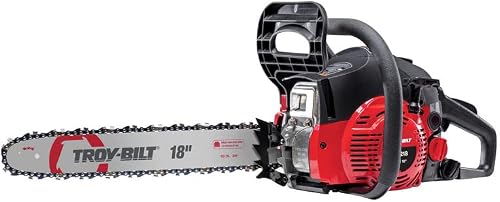
Troy-Bilt Gas Chainsaw: Best for light limbing
- 42cc full-crank 2-cycle engine
- SpringAssist starting
- 18-inch low-kickback bar and chain
- 3-point anti-vibration handles
A 42cc saw with SpringAssist to ease pull starts and an 18-inch low-kickback bar for trimming branches. The automatic oiler and inertia chain brake add safety.
Pros
- SpringAssist eases pull starts
- Automatic bar and chain oiler
- 2-cycle engine oil included
Cons
- Modest 42cc engine for thick logs
- Needs 2-cycle fuel mix
Troy-Bilt's TB4218 is a 42cc saw built for trimming and light cleanup. SpringAssist takes the yank out of pull starts, and the 18-inch low-kickback bar and chain cut through limbs quickly.
An automatic bar and chain oiler handles lubrication, and an inertia-activated chain brake adds kickback protection.
The 3-point anti-vibration handles and a light body keep it comfortable for yard work. The kit includes 2-cycle engine oil, and Troy-Bilt backs it with a 2-year limited warranty.
At 42cc it's the second-smallest engine here after the 40cc Husqvarna 440, so it's best for branches and small logs rather than felling. It also needs 2-cycle fuel mix.
The 15.5 lb figure in the specs sits above its light-body billing, so expect some heft.
Choose it for pruning, storm cleanup and occasional firewood where an easy start and low-kickback bar matter more than torque. Skip it for heavy felling.
Husqvarna 445S 18-inch gas chainsaw: Best for faster cutting
- 50cc X-Torq engine
- 3 hp
- Smart Start
- X-CUT chain
- LowVib dampeners
Husqvarna says this 50cc saw cuts 20% faster than the 445. The X-CUT chain and 3 hp engine make it a strong choice for steady tree trimming.
Pros
- Husqvarna claims 20% faster cutting than the 445
- X-CUT chain holds its edge
- Reinforced crankcase improves cooling
Cons
- Runs on 50:1 mixed fuel
- Heavier than the 440 at 14.3 lb
Husqvarna bills the 445S as 20% faster cutting than the 445, and its 50cc 3 hp X-Torq engine backs that up. The X-CUT chain is built to hold a sharp edge longer, and the reinforced crankcase improves cooling during long sessions.
Smart Start and an inertia chain brake come standard.
LowVib dampeners sit between engine and chassis to reduce in-hand vibration. A slimmer body helps handling, and the recommended bar range runs from 13 to 20 inches.
The kit includes the saw, and Husqvarna offers a 2-year limited warranty that extends to 5 years with a qualifying pre-mixed fuel purchase.
The trade-off is weight: 14.3 lb against the 9.8 lb of the 440. That heft buys more power for steady tree trimming and mid-size felling.
It runs on Husqvarna 2-stroke lubricant at 50:1.
Pick the 445S when you want faster cutting and can handle the extra weight. Pick the 440 instead for all-day trimming and easy starts.
Our gas chainsaw overview helps frame the size choice.
Husqvarna 445 Gas Chainsaw: Best for balanced all-around use
- 50cc X-Torq engine
- 2.8 hp
- Smart Start
- Air Injection
- LowVib dampeners
The 50cc 445 balances power and weight for general yard work. Smart Start, Air Injection and LowVib come standard on this slimmer-body saw.
Pros
- Mid-size 50cc engine
- Smart Start and combined choke/stop control
- Weighs 11.2 lb
Cons
- Slightly less power than the 445S
- Runs on 50:1 mixed fuel
The Husqvarna 445 is the balanced all-rounder of the lineup. Its 50cc X-Torq engine makes 2.8 hp, a step below the 445S but with the same emissions and fuel-efficiency benefits.
A slimmer body keeps it mobile, and the recommended bar range is 13 to 20 inches.
Smart Start, Air Injection and LowVib all come on this saw. The 7-degree offset front handle improves grip, and the combined choke and stop control promotes easier starts.
At 11.2 lb it's lighter than both the 445S and the PROYAMA.
Husqvarna lists a 2-year warranty that extends to 5 years with a qualifying pre-mixed fuel purchase. It runs on Husqvarna 2-stroke lubricant at 50:1.
The reason to choose the 445 over the 445S is weight and handling; the 445S wins on cutting speed. The 2.8 hp engine also trails the 3.5 hp saws for large logs.
Pick the 445 for general yard work and trimming where the lighter body helps. See our guide to gas chainsaws for home use for more options.
How these 18 inch gas chainsaws compare
The table puts the eight saws side by side on engine, bar length and rated power. Read down the score column first, then check the engine and bar specs against your own cutting.
| Product | Best for | Engine | Bar length | Power | Our score |
|---|---|---|---|---|---|
| SENIX 4-Cycle 18-Inch Gas Chainsaw | no fuel mixing | 49cc 4-cycle | 18 inches | 3.5 hp | 8.9 |
| PROYAMA 62cc Gas Powered Chainsaw | two-bar versatility | 62cc 2-cycle | 18 and 22 inches | 3.5 hp | 8.4 |
| QWD 61.5CC 18-Inch Gas Chainsaw | firewood cutting | 61.5cc 2-cycle | 18 inches | 2.75 hp | 8.3 |
| KAKEI 61.5CC 18-Inch Gas Chainsaw | value firewood work | 61.5cc 2-cycle | 18 inches | 2.75 hp | 8.2 |
| Husqvarna 440 18-inch gas chainsaw | easy starting | 40cc 2-cycle | 18 inches | 2.4 hp | 8.1 |
| Troy-Bilt Gas Chainsaw | light limbing | 42cc 2-cycle | 18 inches | 3.5 hp | 7.9 |
| Husqvarna 445S 18-inch gas chainsaw | faster cutting | 50cc 2-cycle | 18 inches | 3 hp | 7.7 |
| Husqvarna 445 Gas Chainsaw | balanced all-around use | 50cc 2-cycle | 18 inches | 2.8 hp | 7.6 |
How we picked and scored these saws
We compared the published specs of eight 18-inch gas chainsaws and scored each on the features that matter for home owners: engine displacement and power, bar and chain setup, starting system, anti-vibration design and included kit. The score weighs those against what an 18-inch buyer usually needs.
A four-stroke engine with no fuel mixing earns more than a saw that adds a mixing step. We gave the top score to the SENIX because it removes fuel mixing while still delivering 3.5 hp.
Saws with smaller engines or heavier builds scored lower even when their features are solid. We didn't test the saws in the field.
Every score is a judgment from the specs and the job each saw is built for.
What should you check before buying an 18 inch gas chainsaw?
Check the engine size and the fuel type first. An 18-inch bar pairs with anything from 40cc to 62cc, and the engine you choose decides how much torque you get in thick wood.
Fuel type decides your daily routine.
Displacement sets the pace. A 40cc saw like the Husqvarna 440 suits trimming and small firewood.
A 49cc to 50cc engine handles mixed yard work.
A 61cc to 62cc saw brings the torque for steady firewood cutting and larger logs. Bigger engines add weight, so match displacement to your usual cutting load rather than buying the largest saw you can afford.
Two-stroke or four-stroke?
Two-stroke engines are lighter for their power and need a fuel-oil mix. Most saws here run 2-cycle mix: 40:1 on the QWD and KAKEI, 50:1 on the Husqvarna models.
The SENIX is the exception, with a 4-cycle engine that takes straight gasoline and separate crankcase oil. If mixing fuel frustrates you, the four-stroke saves that step.
If you want the lightest saw for its power, a two-stroke usually wins.
What bar and chain specs matter?
Bar length alone doesn't tell you what chain to buy. Match pitch, gauge and drive links.
The QWD and KAKEI 18-inch saws use .325-inch pitch, .050-inch gauge and 72 drive links. A mismatch means the chain won't seat on the sprocket or bar.
Check oil flow and tension before each cut, and retension a new chain as it stretches.
How much does an 18 inch gas chainsaw weigh?
Weights here run from 9.8 lb to 16 lb. Lighter saws cut fatigue during overhead limbing and long trimming sessions.
Heavier saws bring more torque for thick logs but tire your arms faster.
The Husqvarna 440 is lightest at 9.8 lb. The 445 weighs 11.2 lb, the PROYAMA 14 lb and the 445S 14.3 lb.
The SENIX specs list 16 lb, though SENIX also describes it as 12.6 lb elsewhere. Treat the lower figure as the maker's dry-weight claim and expect the saw to feel heavier with a full fuel tank.
For overhead work, a lighter saw like the 440 pays off. For ground-level firewood, the extra weight of the 61cc saws is easier to accept.
Which saws suit overhead limbing?
Pick the Husqvarna 440 or 445 when most of your cutting happens above shoulder height. Their light bodies and LowVib handles reduce strain.
Pick a 61cc saw when you mostly cut at ground level.
Which starting system is easiest to live with?
Smart Start and SpringAssist are the two ease-of-start features in this group. Both reduce pull effort, but they work on different engines.
Husqvarna's Smart Start appears on the 440, 445S and 445. It lowers the effort needed on the recoil starter and pairs with a combined choke and stop control that lowers flooding risk.
Troy-Bilt's SpringAssist adds a spring to the pull cord on its 42cc engine. The SENIX four-stroke starts without a fuel mix to foul the plug.
The PROYAMA and QWD use conventional recoil starters with primer and choke controls. QWD's manual calls for a defined cold-start routine: close the choke, pull to first ignition, squeeze the throttle to reopen the choke, then pull again.
Follow the maker's sequence and starting gets predictable. Pick a Smart Start Husqvarna if you start the saw often and want the least fuss.
What safety features should an 18 inch gas chainsaw have?
Every saw here includes an automatic bar and chain oiler and an inertia-activated chain brake, though the feature names differ. The chain brake stops the chain when kickback throws the saw, and the automatic oiler keeps the chain lubricated without a manual pump.
Troy-Bilt pairs its brake with a low-kickback bar and chain. Husqvarna uses the inertia-activated brake on all three models.
Wear eye, hearing, hand, leg and foot protection, and let the saw cool before refueling. QWD and KAKEI both advise stopping the engine and letting it cool if you notice unusual heat, odor, smoke or power loss.
How to mix gas for chainsaw fuel
Most saws here run on a two-stroke mix. Check the ratio on your model before filling: 40:1 on the QWD and KAKEI, 50:1 on the Husqvarna models.
Use fresh gasoline and the matching 2-cycle oil.
The QWD kit includes a 40:1 mixing bottle, so you can measure accurately. Mix only what you'll use in a few weeks, because gasoline goes stale.
Our how to mix gas for chainsaw walkthrough covers ratios and storage. The SENIX four-stroke skips all of this: fill the fuel tank with straight gas and keep the crankcase oil separate.
If you want a simpler fill routine, that's the main reason to choose it over a two-stroke saw. Never run a two-stroke on straight gasoline.
Check the oil level on a four-stroke before each session and change it on the schedule in the maker's instructions.
Which 18 inch gas chainsaw should you buy?
The SENIX 4-Cycle 18-Inch is the best 18 inch gas chainsaw for most home owners, because straight gasoline and an 18-inch bar cover everyday firewood and storm cleanup without a mixing routine. Buy the PROYAMA 62cc when you want both an 18-inch and a 22-inch bar for limbing and felling.
Pick the QWD or KAKEI for steady firewood cutting with large tanks and a complete kit. Choose the Husqvarna 440 when easy starts and light weight matter most, or the 445S when you want faster cutting and can handle 14.3 lb.
The 445 is the balanced middle ground for general yard work. If you're still unsure whether gas is right for you at all, start with our gas chainsaw buyer's guide and then come back to this list.
Our top 3 picks at a glance
-
1
-
2
-
3
Frequently asked questions
What size engine do I need for an 18 inch gas chainsaw?
An 18 inch bar pairs well with a 40cc to 50cc engine for trimming and firewood, while a 61cc to 62cc engine gives more torque for larger logs. More displacement adds weight and fuel use, so match the engine to your usual cutting load.
Is a 2-cycle or 4-cycle gas chainsaw easier to own?
A 4-cycle saw runs on straight gasoline, so you skip measuring and mixing two-stroke oil. A 2-cycle saw needs a fuel-oil mix such as 40:1 or 50:1 but is lighter for its power.
Pick the 4-cycle if mixing fuel annoys you.
What bar and chain size fits an 18 inch chainsaw?
Check pitch, gauge and drive links before ordering a replacement chain. The QWD and KAKEI 18-inch saws use .325-inch pitch, .050-inch gauge and 72 drive links.
Bar length alone does not tell you which chain fits.
Do I need to break in a new gas chainsaw chain?
Yes. A new chain stretches during its first few cuts, so stop the engine, let it cool and recheck tension after the first cuts and whenever sag appears.
Check oil flow and tension before every use.
Can an 18 inch gas chainsaw fell a large tree?
It can handle medium trunks and limbing well. For large trunks, the PROYAMA's 22-inch bar gives more reach per pass.
Match bar length to trunk diameter and follow the maker's safety guidance.


