Different Types of Chainsaws Explained
The best type of chainsaw for most homeowners is a battery saw or corded electric model, while gas suits longer, heavier cutting. Match the power source and bar length to your work area, wood size and maintenance routine.
On this page (11 sections)
- What are the main types of chainsaws?
- Are gas chainsaws the best choice for heavy cutting?
- When is a corded electric chainsaw the right type?
- Should you choose a battery chainsaw for home use?
- How do gas, corded and battery saws compare?
- Which chainsaw type works best for firewood?
- What bar length should you choose?
- What chain features affect the different saw types?
- Which chainsaw type is easiest to start and control?
- How should you choose between these 3 saws?
- What is the final rule for choosing a chainsaw type?
The best type of chainsaw depends on where you cut, how long you work and what size wood you handle. Corded electric saws suit nearby yard work, battery saws offer cordless convenience, and gas models fit longer outdoor sessions.
The phrase “different types of chainsaws” covers more than the fuel source. Bar length, chain design, motor strength, starting method, handling weight and maintenance all change how a saw fits your work.
A small saw can be easier to control around branches, while a longer bar can reach farther into larger logs. The right choice is the one that gives you enough cutting capacity without adding power, noise or maintenance you don't need.
What are the main types of chainsaws?
The main chainsaw types are gas, corded electric and battery powered, with pole saws serving a separate high-reach role. Each type trades cutting freedom, maintenance, noise and runtime differently.
Gas chainsaws use an engine and fuel. They work away from outlets and do not depend on a battery charge, which makes them useful for extended outdoor cutting and firewood preparation.
Corded electric chainsaws draw power from an outlet. They start immediately and can keep running while connected, but the cord limits movement and requires careful handling around the cutting area.
Battery chainsaws use a rechargeable battery and electric motor. They are easier to move around a yard than corded models, while their work time depends on the battery system and the task.
Pole saws place a smaller cutting head on an extended shaft. They are designed for branches above shoulder height, not for replacing a standard saw during ground-level log cutting.
Choose the power source first, because it determines where you can work and how much routine care the saw needs.
Are gas chainsaws the best choice for heavy cutting?
Gas chainsaws are the best choice for long, mobile cutting sessions, especially when you need sustained operation away from an outlet. They suit firewood preparation, clearing branches and handling outdoor work that can continue for an extended period.
A gas saw carries an engine, fuel and related controls. That adds a fuel routine, but it also removes the need to stay near a power cord or stop for a battery recharge.
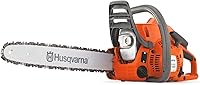
The Husqvarna 135 Mark II 16-inch gas chainsaw has a 38-cc, 2.1-HP X-TORQ engine and a 16-inch bar. Smart Start is designed to help with starting, while the combined choke and stop control helps reduce engine flooding.
Its inertia-activated chain brake is designed to reduce the likelihood of injury from kickback. LowVib technology uses dampeners to reduce vibration, and Air Injection expels larger dust and debris particles before they reach the air filter.
A gas saw is also a practical fit for a property without convenient outdoor power. It can move from one cutting area to another without dragging a cord, which matters during storm cleanup or firewood work.
The trade-off is that gas equipment needs fuel handling and engine care in addition to chain tension, bar oil and sharpening. It also produces more noise than an electric saw.
Pick the Husqvarna for sustained cutting in changing outdoor locations; choose electric power if easy starting and simpler routine care matter more.
When is a corded electric chainsaw the right type?
A corded electric chainsaw is the right type for yard work close to an outlet, including trimming limbs, cutting branches and preparing manageable firewood. It starts immediately and avoids gas-oil mixing.
The Oregon CS1500 corded electric chainsaw uses a 15A motor and an 18-inch guide bar. Its integrated PowerSharp system sharpens the chain in 3 to 5 seconds, and tool-free tensioning lets you adjust the chain with the side cover ring.
Automatic lubrication sends oil from the tank to the bar and chain during operation. The saw also has a chain brake, a low-noise design compared with gasoline models and a 2-year Oregon warranty.
The cord gives you continuous electrical power while you remain within reach of the outlet. That can be useful for repeated cuts in one part of a yard, workshop area or property edge.
The same cord becomes the main limitation once you move farther away. You need to keep it clear of the chain, your feet and the cutting path, and an extension setup can make the work area more complicated.
The Oregon's 18-inch bar is longer than the 16-inch bars on the Husqvarna and EGO examples here. That gives it a different reach and cutting position, but bar length does not remove the need to match the saw to the wood.
Choose the Oregon CS1500 when your cutting stays near reliable power; choose a cordless or gas saw when the cord would control your work area.
Should you choose a battery chainsaw for home use?
A battery chainsaw is the best home-use option when you want cordless movement without gas fuel. It suits yard maintenance, branch cutting and moderate firewood work where the battery system matches the session.
The EGO CS1613 16-inch chainsaw kit includes a 4.0Ah battery and standard charger. Its brushless motor is rated at power equivalent to a 40CC gas chainsaw, with chain speed up to 20 m/s.
The saw uses a 16-inch bar and chain with a 3/8-inch pitch, 0.043-inch gauge and 56 drive links. It also has tool-free chain tensioning, automatic oiling, metal bucking spikes and a kickback brake with a visible brake position indicator.
EGO states that the included battery delivers up to 130 cuts on a 4x4, while the saw is described as capable of up to 220 cuts per charge. Treat those figures as task-dependent guidance because wood size and cutting conditions affect battery use.
The kit is compatible with EGO 56V ARC Lithium batteries, which gives an existing EGO user a reason to stay within that battery system. Weather-resistant construction is rated IPX4.
At 20.9 lb, the complete product is heavier than the Oregon's listed 12.6 lb weight, so handling the kit matters when cutting overhead or working for a long time.
Choose the EGO CS1613 for cordless convenience and a complete battery kit; choose the Oregon for lighter corded handling near an outlet.
How do gas, corded and battery saws compare?
Gas, corded and battery chainsaws differ most in mobility, runtime and routine care. The best match depends on whether your work happens in one powered area or across a larger property.
| Type | Best fit | Main advantage | Main trade-off |
|---|---|---|---|
| Gas | Long outdoor sessions and remote cutting | Works without a cord or battery recharge | Fuel and engine care |
| Corded electric | Nearby branches and repeated cuts by an outlet | Instant startup and continuous connected power | Cord limits movement |
| Battery electric | Mobile yard work and moderate firewood | Cordless operation without gas fuel | Runtime depends on battery charge |
| Pole saw | High branches from the ground | Extra reach for high limbs | Not a general replacement for a standard saw |
Gas is the strongest fit for changing locations and extended work. Corded electric is the simplest fit for a fixed cutting area with power.
Battery electric sits between them, offering movement without fuel.
The products here show the difference in setup. The Oregon has an 18-inch bar and corded power, the Husqvarna has a 16-inch bar and gas engine, and the EGO has a 16-inch bar with a 56V battery system.
No power source makes a saw safe by itself. Chain brake design, tension, balance, bar length and correct cutting technique still matter.
Choose gas for working freedom, corded electric for fixed access to power, and battery electric for cordless home use.
Which chainsaw type works best for firewood?
For firewood, gas is the best choice for long sessions away from an outlet, while battery power is a strong choice for quieter cordless cutting. Corded electric works when the wood pile stays close to electrical power.
The bar must fit the wood and the saw must remain manageable in your hands. A longer bar can reach farther, but it also changes balance and handling.
The Oregon CS1500 has the longest bar among these 3 examples at 18 inches. Its automatic oiler, PowerSharp system and tool-free tensioning support repeated maintenance between cuts.
The Husqvarna 135 Mark II uses a 16-inch bar and supports recommended bar lengths between 14 and 16 inches. Its gas engine, LowVib dampeners and Air Injection suit a homeowner preparing wood in different outdoor locations.
The EGO CS1613 also uses a 16-inch bar. Its brushless motor, 56V battery and stated 4x4 cut capacity make it the cordless option for buyers who want to move around without fuel.
For more focused buying guidance, compare our chainsaw for firewood recommendations after deciding which power source fits your property.
Pick gas for the longest mobile firewood sessions, battery for cordless convenience, and corded electric for a wood pile near the house.
What bar length should you choose?
Choose bar length by the diameter of the wood and your ability to control the saw, not by length alone. A 16-inch bar fits many homeowner tasks, while an 18-inch bar offers more reach for suitable cutting jobs.
The Husqvarna and EGO examples both use 16-inch bars. That gives them a similar nominal reach, but their power sources and handling feel differ because one uses gas and the other uses a battery system.
The Oregon uses an 18-inch guide bar. It can suit larger homeowner cutting tasks than a shorter bar, but the cord still limits where you can use it.
Bar length is not the same as guaranteed cutting capacity. The cut also depends on the wood position, the chain condition, the saw's power and the operator's control.
A longer bar can become tiring if the saw is difficult to hold steady. A shorter bar can be easier to manage around branches and smaller logs, provided it reaches the cut you need.
Start with the smallest bar that handles your regular work. Size up only when your normal wood and cutting position justify the added reach.
Choose 16 inches for common homeowner cutting, and choose the Oregon's 18 inches when you need its longer bar and can work near an outlet.
What chain features affect the different saw types?
Chain features affect cutting feel, maintenance and control across every power source. The chain must stay properly tensioned, lubricated and sharp for the saw to work as intended.
The Oregon combines an automatic oiler with an integrated PowerSharp self-sharpening system. Its sharpening process is designed to take 3 to 5 seconds, which can reduce the time spent away from cutting.
The EGO uses a 3/8-inch pitch, 0.043-inch gauge chain with 56 drive links. Its tool-free tensioning uses a dial, and automatic oiling keeps the bar and chain lubricated during cutting.
The Husqvarna uses a side-mounted tensioning system for slack adjustments. Its chain brake is inertia activated, and the saw is designed for 14 to 16-inch bars.
For a deeper look at replacement chain choices, read our guide to types of chains for chainsaws. Chain pitch, gauge and drive-link count must match the saw and bar.
Keep the chain tension in the correct range for the saw, and add the right bar oil before cutting. A dull or poorly adjusted chain changes the work even when the motor has enough power.
Choose the saw with the chain features that fit your maintenance habits, then keep tension, lubrication and sharpening part of every session.
Which chainsaw type is easiest to start and control?
Corded electric is the easiest starting type because it begins immediately when connected to power. Battery saws also avoid fuel preparation, while gas saws add a starting routine even when their controls are designed to simplify it.
The Oregon CS1500 starts instantly and comes pre-assembled. Its chain brake and lightweight design support a straightforward setup for nearby yard work.
The EGO CS1613 avoids gas and oil mixing, and its kit includes the battery and charger. Its metal bucking spikes help provide a fixed contact point during cuts, while the kickback brake has an easy-to-see position indicator.
The Husqvarna 135 Mark II uses Smart Start for easier starting. Its combined choke and stop control helps reduce the risk of engine flooding, and LowVib dampeners reduce vibration levels for handling.
Control also depends on the complete weight and cutting position. The EGO kit is listed at 20.9 lb, while the Oregon is listed at 12.6 lb.
A lighter saw can be easier to hold, but the right balance for your work matters more than one number.
Choose corded electric for the simplest start, battery for cordless control, and gas when mobile cutting matters more than setup time.
How should you choose between these 3 saws?
Choose the Oregon CS1500 overall for nearby homeowner work, because it combines an 18-inch bar, instant startup, automatic oiling and PowerSharp sharpening. Its cord makes the decision clear: it belongs where dependable electrical access is available.
Choose the Husqvarna 135 Mark II when you need a gas saw for changing outdoor locations. Its 38-cc, 2.1-HP X-TORQ engine, Smart Start, LowVib dampeners and Air Injection make it the right fit for longer mobile yard and firewood work.
Choose the EGO CS1613 when cordless movement is the priority. Its 16-inch bar, brushless motor, included 4.0Ah battery and charger, tool-free tensioning and EGO 56V battery compatibility make it the most complete battery option here.
For readers who already want a gas model, our gas chainsaw guide narrows the choice around engine power, bar length and homeowner use. If brand continuity matters, compare Husqvarna chainsaw options next.
Pick the Oregon for most fixed-area home cutting, the Husqvarna for sustained mobile work, and the EGO for cordless convenience.
What is the final rule for choosing a chainsaw type?
The final rule for choosing among different types of chainsaws is simple: match the power source to your work area, then match the bar to your wood. Power cannot compensate for a saw that is awkward to move or poorly suited to the cutting location.
Choose corded electric when the work stays near an outlet and you want instant startup with simple routine care. Choose battery electric when you need cordless movement and the battery's capacity fits your session.
Choose gas when you will work far from power, cut for longer periods or prepare firewood across a larger property. Accept the added fuel and engine routine as part of that mobility.
Among the examples here, the Oregon CS1500 is the clear overall pick for nearby homeowner jobs. The Husqvarna 135 Mark II is the mobile gas choice, while the EGO CS1613 is the cordless choice with a complete battery kit.
Start with location, choose the power source, then select the shortest bar that handles your regular cuts.
Frequently asked questions
Are gas chainsaws stronger than electric chainsaws?
Gas chainsaws provide sustained cutting without a power cord or battery recharge, which suits extended work and larger outdoor tasks. Electric saws can still handle many homeowner jobs, especially when their bar length, motor or battery system matches the wood being cut.
What type of chainsaw is easiest to maintain?
Corded electric chainsaws usually have the simplest routine because they do not use fuel or an engine air filter. Battery saws also avoid fuel mixing, while gas models need more engine-related care along with chain tension, bar oil and chain sharpening.
Is a 16-inch chainsaw large enough for home use?
A 16-inch chainsaw suits many pruning, branch-cutting and firewood tasks when the wood fits the saw's cutting capacity and the operator can handle the tool safely. Larger wood may call for a longer bar and a saw designed for heavier work.
What is the difference between a corded and cordless chainsaw?
A corded chainsaw runs from an electrical outlet and can keep working without battery changes, but the cord limits where you can cut. A cordless chainsaw uses a rechargeable battery, so it is easier to move around but depends on charge capacity and compatible batteries.