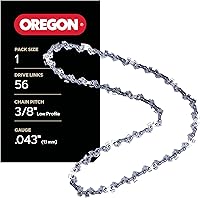
Types of Chainsaw Chains Explained
The main types of chainsaw chains split by cutter shape and by pitch and gauge. A low-kickback semi-chisel chain in 3/8-inch low-profile pitch and .050 gauge suits most homeowner saws, while full-chisel and full-skip designs are built for faster or dirtier cutting.
On this page (10 sections)
- What are the types of chains for chainsaws?
- What cutter profiles exist for chainsaw chains?
- What do pitch and gauge mean for fit?
- Which pitch and gauge should you pick for your saw?
- What is low-kickback chain and when should you choose it?
- How does bar length change the chain you need?
- How many drive links does your chain need?
- Semi-chisel vs full-chisel: which should you buy?
- How should you sharpen and maintain your chain?
- Which chain should you buy first?
The main types of chainsaw chains split by cutter shape and by pitch and gauge, and both matter when you buy a replacement. Cutter shape sets how the chain cuts and how well it holds an edge; pitch and gauge set whether it fits your saw.
Start with the stamps on your old chain or bar. A homeowner saw usually runs a 3/8-inch low-profile chain in .050 gauge, and a matching low-kickback semi-chisel loop is the safe default for firewood, storm cleanup and light limbing.
This guide breaks the chain family down by cutter profile, pitch, gauge, drive links and safety features. You'll also see how bar length changes the loop, and why a sharpener and protective gear belong in the same kit as your spare chain.
What are the types of chains for chainsaws?
The types of chains for chainsaws fall into three cutter profiles (semi-chisel, full-chisel and chipper) and three common pitch classes (.325, 3/8 low-profile and full 3/8). Cutter profile decides how the chain cuts; pitch, gauge and drive links decide fit.
Cutter profile describes the shape of the cutting tooth. Pitch is the distance between drive links, gauge is the thickness of the drive link where it rides in the bar groove, and drive link count gives the loop its length.
A chain can share a pitch with another and still not fit your bar.
That is why a full "types of chains" list includes fit dimensions as well as cutting styles. Ordering by cutter shape alone can leave you with a loop that won't sit in the groove or runs the wrong length.
The table below is the quick map. Each row points to a section further down.
| Group | Main choices | What it decides |
|---|---|---|
| Cutter profile | Semi-chisel, full-chisel, chipper | Cutting speed, edge life, finish |
| Pitch | .325, 3/8 low-profile, full 3/8 | Fit and the size of the cutters |
| Gauge | .043, .050, .058 | Fit in the bar groove |
| Drive links | Varies by bar length and pitch | Loop length |
| Safety design | Low-kickback vs standard | Kickback resistance |
| Bar length | 14 to 20 in and up | Reach and saw balance |
Work down the list in that order. Profile first, then fit, then safety and length.
Pick a semi-chisel low-kickback chain in your bar's pitch and gauge for general yard work, and only move to full-chisel once your wood is clean and your filing is consistent.
What cutter profiles exist for chainsaw chains?
There are three cutter profiles on the market: semi-chisel, full-chisel and chipper. Semi-chisel is the best all-rounder for homeowners, full-chisel is for fast cuts in clean wood, and chipper is for rough, dirty work.
Semi-chisel has a rounded working corner. That round edge holds up in gritty firewood, frozen logs and dirty bark, and it tolerates less precise filing.
Oregon's S56 combo chain uses a heat-treated semi-chisel cutter, and the round profile keeps cutting when the wood isn't pristine.
Full-chisel has a square working corner that slices faster through clean timber. It leaves a smoother finish in softwood and needs a sharp file and steady hand.
A rocked or poorly filed full-chisel chain loses its advantage quickly.
Chipper has a rounded, scoop-like cutter that moves chips well and shrugs off grit. It cuts slower in clean wood and is more common on older or low-power saws.
How each profile holds up in real wood
The right profile depends on what you cut and how often you sharpen. Clean, freshly felled timber rewards full-chisel; yard cleanup and pallet wood favor semi-chisel.
- Semi-chisel: best edge life in dirty or frozen wood, forgiving to file, good speed. The safe choice for most homeowners.
- Full-chisel: fastest in clean hardwood and softwood, smoother finish, but dulls faster and needs careful filing.
- Chipper: tough in gritty or mixed material, slower in clean cuts, and best matched to smaller or older saws.
The trade-off is speed against edge life. A full-chisel chain that goes dull in dirty bark ends up cutting slower than a semi-chisel that stays sharp.
Choose semi-chisel if you cut unknown wood, storm debris or frozen logs. Step up to full-chisel when your firewood is clean and you'll keep it filed.
What do pitch and gauge mean for fit?
Pitch and gauge are the two measurements that decide whether a chain sits on your bar. Pitch is the distance between drive links; gauge is the drive link thickness in the bar groove.
Both must match the bar.
Pitch comes in fractions tied to the sprocket. Common sizes are .325 inch, 3/8-inch low-profile and full 3/8 inch.
The low-profile version uses smaller cutters and less power, which suits saws up to about 42 cc.
Gauge runs .043, .050 and .058 inch in most homeowner sizes. The drive link's tang slides in the bar groove, so a .050 gauge chain needs a .050 gauge bar.
A gauge mismatch makes the chain sloppy or tight and wears the bar.
Drive link count sets the loop length for a given bar and pitch. A 16-inch, 3/8 low-profile bar usually takes 56 drive links.
Count the links on your old chain or read the number stamped on a drive link.
If you need help decoding these numbers, our guide to chainsaw chain size walks through pitch, gauge and drive links step by step.
Which pitch and gauge should you pick for your saw?
Match pitch and gauge to the saw's engine size and bar, not to the biggest numbers you can find. Homeowner and battery saws up to about 42 cc run best on 3/8-inch low-profile chain in .050 gauge.
Full 3/8 pitch is heavier and needs more power. It's common on larger gas saws and pro models where the extra mass and speed pay off.
A small saw fitted with full 3/8 chain bogs down and wears its clutch.
.325 pitch sits between the two. It's used on mid-size saws and offers more cutter than low-profile without the weight of full 3/8.
Check your saw's sprocket before switching pitch classes; the drive sprocket must match the chain pitch.
Gauge follows the bar. A .050 gauge bar needs .050 gauge chain, while narrow-kerf bars use .043.
Don't mix them.
Matching a chain to a homeowner saw
The Oregon 16-inch bar and chain combo in B00004RA71 is the simplest example. It pairs a 16-inch bar with an S56 chain in 3/8-inch pitch, .050 gauge and 56 drive links.
The combo fits saws up to 42 cc, including models from Craftsman, ECHO, Earthwise, Homelite, Makita, Poulan, Ryobi and Wen. Oregon lists a long set of fit models, from the Craftsman CMECS600 to the Ryobi RY3716.
Its LubriTec oiling system feeds oil to the bar and chain to reduce friction. The chain meets the ANSI B175.1-2012 kickback performance requirement.
For a first replacement, buying the bar and chain together removes the fit guesswork.
Pick a matched bar-and-chain combo when your old bar is worn or you're unsure of the size. If the bar is still good, order just the loop to the same pitch, gauge and drive link count.
What is low-kickback chain and when should you choose it?
A low-kickback chain reduces the chance and force of kickback through bumper drive links and a shaped depth gauge. It's the right choice for casual cutters and anyone new to a saw, and it still cuts well when sharp.
Kickback happens when the bar nose contacts wood and the saw jumps back toward the operator. A low-kickback chain limits how much the cutter bites at the nose.
It doesn't remove the risk; technique, a sharp chain and protective gear still matter.
The trade-off is a slightly slower cut than a full-chisel chain without bumpers. For yard work and occasional firewood, most people won't notice the difference.
Pros cutting all day often choose standard chain and rely on training and gear.
Oregon's S56 chain uses bumper drive links and meets the ANSI B175.1-2012 kickback performance requirement. Its low-vibration design also eases arm fatigue over a long session.
If you're new to saws, pair a low-kickback chain with a chainsaw helmet and chainsaw chaps before your first cut. Safety gear is the other half of the decision.
How does bar length change the chain you need?
Bar length changes the loop length and drive link count, so the same pitch and gauge need a different chain when the bar gets longer. A 16-inch low-profile bar takes fewer links than an 18-inch bar of the same pitch.
Longer bars reach bigger trunks and let you cut without bending as much. They also add weight, and they need more engine power to pull the chain.
A 42 cc saw is usually happiest with a 16 to 18-inch bar; a 14-inch bar suits smaller saws and light limbing.
When you change bar length, the chain must match the new bar's pitch, gauge and drive link count. The sprocket at the back of the saw must also match the pitch class.
Bar length is measured as the usable cutting length, not the whole bar. Oregon's 16-inch combo bar takes a 56-link chain in 3/8 low-profile and .050 gauge.
Going to an 18-inch bar would need a longer loop.
Stay with the bar length your saw was sold with unless you have a reason to change it. A longer bar on a small engine costs more in power than it gains in reach.
How many drive links does your chain need?
Drive link count is the number of links in the loop, and it's set by bar length and pitch. A 16-inch, 3/8-inch low-profile bar usually takes 56 drive links, while an 18-inch bar of the same pitch takes more.
Count the links on your old chain or read the number stamped on one of the drive links. Don't count cutters; count drive links, the tangs that ride in the bar groove.
A loop with the wrong count won't fit the bar's nose sprocket and may run too tight or too loose.
When you order a replacement, pitch, gauge and drive link count should all appear in the product name. Oregon's S56 chain name stands for its fit: S for the low-profile family and 56 for the drive links.
A chain sold as "16 inch" without a link count can fit several bars. Check the full spec before buying.
A replacement loop for a 16-inch bar
The Oregon 16-inch chain in B08S7S2RTJ is a 3/8-inch low-profile, .050 gauge loop with 56 drive links. It's the replacement chain for a 16-inch bar on saws up to 42 cc.
Oregon lists fit models across Husqvarna, ECHO, Craftsman, Greenworks, Makita, McCulloch, Poulan and Ryobi. The Husqvarna models marked in the fit list need a 3/8-inch low-profile sprocket.
It's sold as a 3-pack.
The chain has bumper drive links and a depth-gauge design for reduced kickback. It meets the ANSI B175.1-2012 requirement when tested to that standard.
Pick a link-count-specific replacement when your bar and sprocket are in good shape. You'll keep the bar and refresh the cutting edge for less than a full combo.
Semi-chisel vs full-chisel: which should you buy?
The choice between semi-chisel and full-chisel comes down to your wood and your filing. Buy semi-chisel for dirty, frozen or mixed wood and full-chisel for clean timber you'll keep sharp.
Semi-chisel's round corner resists dulling from grit and bark. It's the safer default for homeowners who cut whatever comes their way: storm limbs, pallets, old fence posts.
Filing it is forgiving.
Full-chisel's square corner cuts faster and cleaner in fresh timber. It rewards a steady file hand and frequent touch-ups.
One rock or a patch of dirt and the edge degrades fast.
The speed gap matters most in clean hardwood and production cutting. For a few cords a year in mixed wood, semi-chisel's edge life usually wins.
Choose semi-chisel unless you have clean wood and a filing routine. Then a full-chisel chain in the same pitch and gauge will cut faster for the same engine.
How should you sharpen and maintain your chain?
Sharpening keeps any chain type cutting straight and safely. File the cutters at the angle the chain was ground to, and set the depth gauges to the maker's spec.
A sharp chain cuts faster and kicks back less.
File every cutter on one side, then the other, keeping the same number of strokes. A file guide holds the angle and shows the depth gauge setting.
Oregon's S56 chain is designed for easy maintenance, and regular filing keeps it there.
Check the depth gauges (rakers) after several sharpenings. If they sit too high, the cutters can't bite; too low and the chain grabs.
A combination guide handles both the cutter angle and the depth gauge.
Replace the chain when cutters are filed back to the witness mark or the chain won't stay sharp. A stretched or damaged chain should go too.
Our guide to the best chainsaw sharpener covers file kits and electric sharpeners. A file kit is the simplest way to keep a chain sharp in the field.
A file kit for 3/8-inch pitch chain
The Husqvarna 3/8-inch chainsaw file kit in B0035AKJN0 includes a file handle, a combination file guide with a 2-in-1 roller guide and depth gauge, two round files and a flat file. It's made for 3/8-inch pitch chains, including the Husqvarna H42, H45, H46 and H48 families.
The combination guide holds the correct filing angle, which takes the guesswork out of touch-ups. The flat file handles depth gauges.
The comfortable handle keeps control during sharpening.
It's a fit for anyone running 3/8-inch pitch chain who wants a repeatable edge. A sharp chain also reduces kickback, so the kit supports safe cutting as well as speed.
Pick a guided file kit if you sharpen your own chain. It's the cheapest way to keep any chain type working like it should.
Which chain should you buy first?
Buy the chain that matches your bar's pitch, gauge and drive link count, then choose the cutter profile for your wood. For most homeowners, a semi-chisel low-kickback chain in 3/8-inch low-profile pitch and .050 gauge is the best first buy.
If your bar is worn or you don't know its size, the Oregon 16-inch bar and chain combo is the safest start. It pairs a matched bar with a 56-link S56 chain for saws up to 42 cc.
If the bar is good, order the replacement loop to the same fit. Then keep it sharp with a guided file kit, and wear a helmet and chaps while you cut.
The main types of chains for chainsaws come down to fit and cutter shape. Get those right and the saw does the rest.
For fit numbers in more detail, revisit our chainsaw chain size guide, and read the best chainsaw chaps before your next session in the wood.
Frequently asked questions
What is the difference between semi-chisel and full-chisel chain?
A semi-chisel cutter has a rounded working corner that holds an edge longer in dirty or frozen wood. A full-chisel cutter has a square corner that cuts faster in clean timber but dulls sooner.
Homeowners usually do better with semi-chisel; full-chisel rewards clean wood and frequent filing.
Does chain pitch and gauge need to match the guide bar?
Yes. Pitch is the distance between drive links, gauge is the thickness of the drive link where it sits in the bar groove, and drive link count sets the loop length.
All three must match the bar.
A mismatch can damage the bar and sprocket, so read the stamps on your old chain first.
Is a low-kickback chain safer for beginners?
A low-kickback chain reduces the chance and force of kickback through bumper drive links and depth-gauge design. It still needs safe cutting technique, a sharp chain and the right protective gear.
Oregon's S56 chain meets the ANSI B175.1-2012 kickback performance requirement, so it's a sensible starting point.
How often should I sharpen a chainsaw chain?
Sharpen when the chain throws fine dust instead of chips or pulls to one side in the cut. Touch up the cutters every tank or two of fuel in clean wood.
A file kit with a guide keeps the angle consistent, and a sharp chain cuts faster and kicks back less.
Can I use any chain on my chainsaw bar?
No. The chain's pitch, gauge and drive link count must match the bar, and the bar's motor mount must match the saw.
A chain with the wrong gauge can sit loose in the groove or bind, and too few or too many drive links leaves the loop the wrong length.