Chainsaw Safety Gear: What to Buy for Home Use
For home chainsaw work, cover your legs, head, eyes, ears and hands with suitable protective gear. Choose chaps made for your saw type, a helmet with face and hearing protection, and gloves that fit and suit the task.
On this page (7 sections)
- What chainsaw safety gear do you need at home?
- How do you choose chainsaw chaps for home use?
- Should you buy a chainsaw helmet with a face shield?
- Which gloves make sense for occasional cutting?
- Is a complete chainsaw safety kit a good choice?
- What should you check before each cutting job?
- Which chainsaw safety gear should you buy first?
Chainsaw safety gear for home use should cover your legs, head, eyes, ears and hands. Choose protective clothing suited to your saw, then check that it fits and follows both the saw and gear instructions.
A helmet and chaps do not make risky cutting safe. Use the saw only for work you can handle from a stable position, and keep other people clear of the cutting area.
For most homeowners, the practical starting point is leg protection, a forestry helmet with face and hearing protection, and gloves. You may be able to get several items in one kit, or choose them separately to match your size and saw.
What chainsaw safety gear do you need at home?
Start with protective legwear, head and face protection, hearing protection, gloves, sturdy footwear and close-fitting clothing. Match each item to your saw, the job and its instructions.
| Gear | What it helps protect | Check before use |
|---|---|---|
| Chainsaw chaps or protective pants | Legs | Saw compatibility, coverage and fit |
| Forestry helmet | Head | Condition, fit and replacement guidance |
| Face shield and eye protection | Face and eyes | Visibility, damage and required eye protection |
| Hearing protection | Ears | Fit and the saw maker’s guidance |
| Gloves | Hands and grip | Fit, orientation and whether protection is provided on one or both hands |
| Sturdy footwear | Feet and footing | Fit, sole condition and protection appropriate to the job |
A helmet’s face shield and hearing protectors are useful features, but check whether the instructions call for additional eye or hearing protection. For leg protection, check the saw type as well as the garment’s size and coverage.
How do you choose chainsaw chaps for home use?
Choose chaps that fit your body and are specifically suitable for your saw. Protective legwear can reduce risk, but it cannot prevent every injury or replace safe cutting habits.
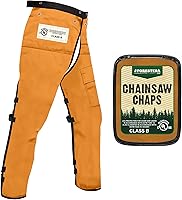
Apron-style chaps cover the front of your legs and are designed to go on and off without putting on a full pair of pants. Check the waist and length measurements against your body, and read the manufacturer’s instructions for coverage and use.
Forester says its chaps meet OSHA 1910.266, ASTM F1897 and CAN/BNQ 1923-450 M91 39JY Class B standards. Follow its sizing and use guidance, since proper fit and saw compatibility matter.
Do not assume one type of chaps works with every saw. Forester specifically warns against using these chaps with electric chainsaws because of their high-torque motors.
Check the instructions for any chaps you consider and the manual for your saw.
For a closer look at styles and fit, read our guide to the best chainsaw chaps for home use. Our article on what chainsaw chaps are and whether you need them explains their purpose and limits.
Should you buy a chainsaw helmet with a face shield?
A forestry helmet with an integrated shield and ear muffs can bring head, face and hearing protection together. Choose one that fits securely, and check its instructions for setup, care and any additional eye protection you need.
The Husqvarna helmet in this guide has an HDPE shell, a metal mesh face shield, adjustable ear muffs and a sun peak. Its six-point textile suspension has three depth settings, and its ear muffs adjust vertically and sideways.
Husqvarna says the helmet meets and exceeds ISEA/ANSI Z89.1-2014 Type I with electrical insulation and is rated Class E. Its ear muffs have a 24 dB NRR rating.
These details do not tell you whether it fits your head or suits a particular worksite.
A mesh shield can protect against debris, but it does not replace any additional eye protection required by the helmet or saw instructions. Inspect the shield, suspension and ear muffs before use, and replace damaged parts as directed.
See our chainsaw helmet guide for more on fit and features to compare.
Which gloves make sense for occasional cutting?
Choose gloves that fit your hands and suit the task, then check which hand receives chainsaw protection. A glove made for one hand does not provide the same protection on the other.
The Oregon glove here is extra large and designed for left-hand protection. Oregon says its extra-thick left-hand material meets EN ISO 11393-4, Class 0, 16 m/s, and describes the palms as reinforced for grip.
Check your fit and read the glove instructions before wearing it, especially if you need protection for both hands.
Gloves are one part of a complete gear setup. They do not replace chaps, a helmet or other protection your saw instructions recommend.
Is a complete chainsaw safety kit a good choice?
A kit can simplify shopping when its contents, sizes and protection match your needs. Check each item rather than assuming that one bundle will suit every homeowner.
The Husqvarna Classic Power Kit with chaps includes chaps sized for a 36 to 38 in waist with a 32 in inseam, a forest helmet, and large gloves. The helmet includes a face shield and ear muffs.
Husqvarna says the kit’s chaps and helmet meet ASTM F1897, ANSI Z133.1 and OSHA Regulation 1910-26. This kit may suit you if its sizes and equipment match your needs, but it may not fit if you need another chap or glove size.
Check that all the pieces fit before working. A helmet that shifts or chaps that do not cover as intended can get in the way of the task.
What should you check before each cutting job?
Before starting, check your equipment, saw and work area. A quick inspection helps you catch visible damage and fit problems before handling a running chain.
- Confirm chaps and other protective clothing are intended for your saw type.
- Check the helmet fits securely and inspect its shell, suspension, shield and ear muffs.
- Make sure gloves fit and that any hand-specific protection is on the correct hand.
- Wear sturdy footwear and clothing that will not snag on branches or controls.
- Follow the saw manual for setup, operation and protective equipment.
- Clear people and pets from the work area, and keep a stable footing and escape route.
Do not use damaged gear or gear that no longer fits as intended. Follow the manufacturer’s instructions for inspection, cleaning, storage and replacement.
If a job involves overhead branches, unstable wood or a position where you cannot control the saw, pause and get help from a qualified tree care professional. For basic sizing before you choose a saw, see what chainsaw bar length you need.
Which chainsaw safety gear should you buy first?
Buy a compatible set of leg protection, a well-fitting helmet with face and hearing protection, and suitable gloves before cutting. Choose the Husqvarna kit if its sizes and components fit your needs, or select separate items when you need a different fit or saw compatibility.
If you are comparing chaps, start with our home-use chainsaw chaps picks. For any setup, follow the saw and gear instructions every time you work.
Frequently asked questions
What safety gear do I need to use a chainsaw at home?
Wear chainsaw protective legwear suited to your saw, a helmet with eye and hearing protection, gloves, sturdy footwear and close-fitting clothing. Check your saw’s manual and the protective gear instructions before each job, and make sure every item fits securely.
Are chainsaw chaps suitable for electric chainsaws?
Check the chap instructions and your saw manual before choosing leg protection. Forester’s chaps are not suitable for electric chainsaws because of their high-torque motors, so choose protective clothing specifically approved for your saw type.
Does a chainsaw helmet replace safety glasses?
A helmet with a face shield can help protect your face from debris, but check the helmet and saw instructions to see what eye protection is required. Keep the shield in good condition, and use additional protection if the instructions call for it.
Do chainsaw gloves protect both hands?
Not every chainsaw glove protects both hands. The Oregon glove here is designed for left-hand protection, so check the glove’s orientation and instructions, then choose gloves that fit your grip and the work you plan to do.
Do chainsaw chaps make cutting safe?
No protective clothing guarantees complete safety. Chaps are intended to reduce injury risk in specific conditions, but they do not replace safe operating procedures, training, maintenance or the instructions for your saw and protective gear.