9 Best Chainsaws for Cutting Logs (November 2026)
The best chainsaws for cutting logs include the SUPMIXTOOLS 62cc Gas Chainsaw 20 Inch Gas for bucking thick trunks, the Supstable Mini Chainsaw Cordless for small logs and branches, and the SEESII 40V Eectric Chainsaw Cordless 16 Inch (best cordless for yard log piles).
On this page (8 sections)
The best chainsaw for cutting logs for most people is the SUPMIXTOOLS 62cc 20 Inch, because its 20-inch bar clears most trunks in a single pass and its 62cc engine keeps speed through a long session. If your logs are smaller or you'd rather skip fuel and fumes, the cordless and mini options below do the job well.
Cutting logs is different from felling trees. Most of the work is bucking: taking a trunk already on the ground and slicing it into rounds.
That job rewards bar length and steady engine speed more than raw top-end power.
A saw with a 20-inch bar reaches across most firewood trunks without repositioning, and an engine in the 50 to 60cc range holds its revs when the chain stays buried in hardwood. Go bigger than that and you gain reach but pay for it in weight over a long session.
Go smaller and you save your arms but cut more slowly on thick rounds.
This guide covers both ends and the middle. If your main task is trimming branches rather than bucking trunks, the best chainsaws for firewood guide covers that angle in more detail.
For a wider look at fuel-powered options in general, see the best gas chainsaws roundup.
Our picks at a glance
-
1
 Best for bucking thick trunks
SUPMIXTOOLS 62cc Gas Chainsaw 20 Inch Gas
9.7/10 our score
See it on Amazon -
2
-
3
 Best cordless for yard log piles
SEESII 40V Eectric Chainsaw Cordless 16 Inch
9.4/10 our score
See it on Amazon
- 4
 Check it
FXAFXA 12" Electric Chainsaw Cordless
Best light cordless for firewood rounds - 5
 Check it
Husqvarna 120 Mark III 16-inch gas chainsaw
Best for homeowners starting out - 6
 Check it
WORKIT 25.4CC Gas Powered Chainsaw
Best top-handle for limbing and tight spots - 7
 Check it
DOOYUTOOL 10 Inch Cordless Chainsaw for DEWALT
Best for DEWALT battery owners - 8
 Check it
Husqvarna 460 Rancher 24-inch gas chainsaw
Best for large-diameter logs - 9
 Check it
XtremepowerUS 22-Inch Gas Chainsaw
Best for land and storm cleanup
Best chainsaws for cutting logs
The SUPMIXTOOLS 20-inch gas saw is the top pick for most log-cutting jobs. The rest of the list fills in specific needs: lighter saws for smaller rounds, battery saws for quiet work near the house, and long bars for wide trunks.
Pick by the size of your biggest logs first, then by how much weight you want to carry.
SUPMIXTOOLS 62cc Gas Chainsaw 20 Inch Gas: Best for bucking thick trunks
- 62cc 2-cycle engine
- 20-inch low-kickback bar
- Quick-stop chain brake
- 14 lb
A 20-inch bar and 62cc engine give you the reach and torque to cut large logs down to stove length without stopping between rounds.
Pros
- 20-inch bar handles thick trunks
- Strong 62cc engine for steady cutting
- Chain brake and safety switch
Cons
- Heavier than most picks here
- Needs fuel mixing and pull starting
SUPMIXTOOLS suits anyone bucking real trunks into firewood rounds. The 20-inch bar with a low-kickback chain takes on larger logs and branches, so you aren't always rolling a trunk to finish a cut.
A 62cc 2-cycle engine gives strong power with less vibration than you might expect from a saw this size.
The well-balanced body and ergonomic grips keep fatigue down over a long session. Safety comes from a quick-stop chain brake and a switch that guards against accidental starts.
It weighs 14 lb, which is manageable for short jobs but adds up when you're bent over a log pile for hours. The engine runs on mixed fuel at a 2-stroke ratio, so budget for a can and a funnel before your first session.
The 20-inch bar is the sweet spot for most firewood work, big enough for thick rounds without the extra reach of a 24-inch saw. The kit includes an installation toolkit.
It's also sold as a do-it-all saw for felling and carpentry, not just firewood. Skip it if your logs are small and light; a mini or cordless saw will be easier to carry.
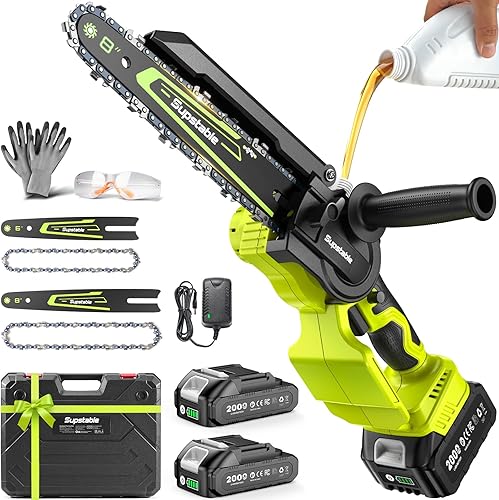
Supstable Mini Chainsaw Cordless: Best for small logs and branches
- 6-inch and 8-inch guide bars
- 1000W brushless motor
- Two 2000mAh batteries
- 3.3 lb
Two swappable bars and a light body make short work of kindling and small rounds where a full-size saw would be overkill.
Pros
- Two bar sizes in one kit
- Very light at 3.3 lb
- Auto-oiler and two batteries
Cons
- Short bars limit log diameter
- Not built for large trunks
Supstable suits anyone with a pile of branches and small logs rather than full trunks. It's 3.3 lb, which is a fraction of a gas saw's weight, so you can carry it around the yard without tiring.
The kit gives you two guide bars, 6-inch and 8-inch, so you can switch to the shorter one for fine pruning and the longer one for bigger cuts. The unit itself measures 17.32 by 13.39 by 3.94 inches and packs into the included plastic case.
A 1000W brushless motor drives the chain at 32 ft/s, and two 2000mAh batteries give up to 60 minutes of runtime. An auto-oiler with a 30ml tank keeps the chain lubricated without manual work: fill it and press the bulb.
It arrives with gloves, goggles and two chains in a carry case. Note that the kit includes small oil bottles but no lubricating oil, so buy a bottle of bar oil before your first session.
A 2 year manufacturer warranty backs the tool.
The trade-off is bar length: 8 inches limits you to smaller logs. That's fine for kindling and cleanup and not enough for a 16-inch trunk.
Pick it for small logs and branches, and leave thick trunks to a full-size saw.
SEESII 40V Eectric Chainsaw Cordless 16 Inch: Best cordless for yard log piles
- 2000W 40V brushless motor
- 16-inch bar
- Up to 90 minutes runtime
- 10.3 lb
Battery power with no fumes and no pull cord, and a 16-inch bar that still takes on good-sized rounds near the house.
Pros
- No gas or exhaust fumes
- 16-inch bar for medium logs
- Auto-oiling and tool-free tensioning
Cons
- Needs charging between sessions
- Batteries fit 40V tools only
SEESII suits homeowners with a medium log pile near the house who want to skip gas. Its native 40V brushless motor delivers 2000W and a chain speed around 34.8 ft/s, so it cuts through 16-inch logs without stalling.
Two 40V 4.0Ah batteries and a fast charger give up to 90 minutes of runtime. The native 40V design holds peak voltage instead of dropping like a hybrid 2x20V setup.
A 16-inch bar handles thick logs and wide branches, and the 10.3 lb body stays comfortable to lift. An auto-oiler with a 150ml reservoir and tool-free chain tensioning mean less time fiddling and more time cutting.
A chain brake, safety lock and overload protection cover the safety basics. Goggles and gloves come in the box, and the chain spec is 3/8-inch pitch, .050-inch gauge and 59 drive links.
The maker lists 2 years of spare part availability.
The batteries fit 40V tools only, so they won't run your 20V gear. Charging between sessions is the main cost of going cordless.
Choose it when quiet, fume-free cutting matters more than unlimited runtime.
FXAFXA 12" Electric Chainsaw Cordless: Best light cordless for firewood rounds
- 12-inch bar
- 2.56 hp brushless motor
- Two 4000mAh batteries
- Automatic oiling
A handy 12-inch saw for cutting split wood and smaller logs to length without hauling out a gas machine.
Pros
- Light enough to carry all day
- Two batteries in the kit
- Tool-less chain tension dial
Cons
- 12-inch bar caps log size
- Shorter runtime than a gas saw
FXAFXA suits light firewood work and small rounds where a full-size saw is more than you need. Its 12-inch bar and 2.56 hp brushless motor run the chain at up to 10 m/s and handle thick logs without stalling.
Two 4000mAh batteries come in the kit, along with overload and temperature protection.
A safety hand guard and a double-button start keep accidental cuts out of reach: press the lock, then the start. The 140ml oil tank feeds an automatic lubrication system, and a dial adjusts chain tension without tools.
The manufacturer says this design lowers power consumption by up to 20%. A one-piece guide plate with a hardened manganese steel chain is built to take repeated use.
At 8.2 lb it's easy to carry around the yard.
The trade-off is size: a 12-inch bar won't reach across big trunks. For cutting split wood and smaller logs to length, though, it's a comfortable choice.
Pick it for light-duty log cutting rather than a whole winter's wood supply.
Husqvarna 120 Mark III 16-inch gas chainsaw: Best for homeowners starting out
- 38cc X-Torq engine
- 16-inch bar
- Air purge start
- LowVib handles
An easy-starting gas saw that takes the fuss out of cold mornings and handles everyday log cutting at home.
Pros
- Air purge and choke control for easier starts
- Light for a gas saw at 10.7 lb
- LowVib reduces hand fatigue
Cons
- 38cc limits speed in dense hardwood
- Still needs fuel mixing
Husqvarna's 120 Mark III suits homeowners who want a gas saw that starts without a fight. The 38cc X-Torq engine pairs with an air purge system and a combined choke/stop control that cut the risk of flooding.
An inertia-activated chain brake reduces the chance of injury from kickback.
Centrifugal air cleaning throws out dust before it reaches the filter, which helps engine life. LowVib dampeners reduce vibration so your hands don't wear out as fast.
At 10.7 lb it's light for a gas saw, and the 16-inch bar covers logs up to medium size. A simple tensioning system lets you snug the chain without extra tools.
The engine runs on Husqvarna 2-stroke oil at 50:1, and the tank holds 0.15 L. Pre-mixed fuel can extend the warranty from 2 to 5 years.
The 1.8 hp engine is the limit here: dense hardwood will slow it more than the bigger gas saws above. Pick it for easy starts and light felling or limbing, and step up in engine size if your logs run thick.
Our Husqvarna chainsaw guide compares more models from the brand.
WORKIT 25.4CC Gas Powered Chainsaw: Best top-handle for limbing and tight spots
- 25.4cc Xtreme engine
- 12-inch bar
- Top handle with shock absorption
- 8.2 lb
A small top-handle gas saw for trimming branches and cutting small logs where a full rear-handle model feels clumsy.
Pros
- Very light for a gas saw
- Top handle suits close work
- Auto-oiler and spare plug included
Cons
- Small engine and bar for big trunks
- Top-handle grip demands careful use
WORKIT suits limbing and precision cutting in tight spots, like a crowded woodpile or a fence line. The top-handle design puts the grip over the engine so you can work close to branches.
Its 25.4cc Xtreme engine is small but built for commercial-grade running, with strong heat dissipation. An upgraded reinforced body, heavy-duty bearings and an improved clutch are meant for high-load use.
OptiSpark ignition aims for reliable starts whether the engine is cold or hot. A chain brake, protective baffle and dual safety locks add safety controls.
At 8.2 lb it's light enough to carry all day. The kit includes a 12-inch bar and chain, a spare plug, a pre-mix jug, gloves, goggles and earplugs.
The chain runs 3/8-inch pitch and .050-inch gauge with 45 drive links. It burns fuel as long as you keep filling it, so there's no battery to run down.
The trade-off is capacity: a 12-inch bar and 1.2 hp engine won't cut big trunks quickly. Choose it for limbing and small logs, not for bucking large-diameter wood.
DOOYUTOOL 10 Inch Cordless Chainsaw for DEWALT: Best for DEWALT battery owners
- 10-inch bar
- 1000W brushless motor
- Fits DEWALT 20V MAX batteries
- 4 lb
Runs on batteries you may already own and weighs just 4 lb, so it's ideal for quick cuts and small log piles.
Pros
- Uses DEWALT 20V MAX batteries
- Lightest saw here at 4 lb
- Self-oiling with a clear tank
Cons
- 10-inch bar only
- Battery and charger sold in the kit
DOOYUTOOL suits anyone already invested in DEWALT 20V MAX batteries. It runs on those packs, so you can use spares you own instead of buying a new system.
A 1000W brushless motor in a 4 lb body makes it the lightest saw here. A 10-inch bar is short, so it's best for small logs and quick cleanup.
A self-oiling system starts lubricating the moment you power on, and a clear tank lets you check the level at a glance. A real-time battery display shows remaining charge as soon as it starts.
It comes with a 4.0Ah battery and charger, so it works out of the box even without DEWALT packs. The brushless motor is built for lower energy use and steady power rather than a burst that fades as the battery drains.
The maker lists 12 months of after-sales service.
The short bar is the main limit. Pick it for small jobs and battery-sharing, and look elsewhere for thick trunks.
Husqvarna 460 Rancher 24-inch gas chainsaw: Best for large-diameter logs
- 60.3cc X-Torque engine
- 24-inch bar
- Smart Start
- 13.2 lb
The longest bar here reaches across wide trunks and takes big rounds down in fewer passes, though the extra size is heavier to handle.
Pros
- 24-inch bar for wide logs
- Strong 60.3cc engine
- Smart Start for easier pulls
Cons
- Heavier and longer than most picks
- Overkill for small branches
Husqvarna's 460 Rancher suits landowners with wide trunks and a real volume of wood to cut. Its 24-inch bar reaches across large-diameter logs and takes them down in fewer passes.
The 60.3cc X-Torque engine makes 3.6 hp and holds power at low RPMs.
Smart Start makes pulling easier, and an inertia-activated chain brake guards against kickback. Air Injection cleaning and LowVib handles help engine life and hand comfort.
A 7-degree offset front handle improves grip. It weighs 13.2 lb and its size makes it a two-handed tool for ground-level work.
An automatic adjustable oil pump keeps the chain fed on long cuts. The fuel tank holds 0.32 L and mixes at 50:1.
The saw ships with a bar, chain, a small can of 50:1 mix and a scrench. The manufacturer offers a 2 year warranty, extendable to 5 years with pre-mixed fuel.
The trade-off against the smaller picks is weight and cost: this is a lot of saw for a modest pile of logs. Pick it when your logs run wide and you want a long bar to match.
XtremepowerUS 22-Inch Gas Chainsaw: Best for land and storm cleanup
- 58cc 2-stroke engine
- 22-inch bar
- Aluminum construction
- 19 lb
A big-bar gas saw for clearing fallen trees and cutting logs on rural property, with the heft to match its reach.
Pros
- 22-inch bar for thick logs
- 58cc engine for tough cuts
- No cords or charging needed
Cons
- Heaviest saw in this group
- Short manufacturer warranty window
XtremepowerUS suits rural property owners clearing fallen trees and cutting logs away from power. Its 58cc 2-stroke engine and 22-inch bar give strong cutting reach for thick logs and branches.
The gas design means no cords, outlets or charging, so you can work wherever the wood is.
Aluminum components balance strength with manageable weight. A 22-inch bar gives extended reach for larger logs.
At 19 lb it's the heaviest saw here, so plan to cut in shorter sessions or share the work. It's also the least expensive end of the gas range in terms of features and warranty: the manufacturer offers 60 days.
The saw runs on a 2-stroke fuel mix and needs the usual starting routine of choke and pull cord. The 2.4 hp rating is modest for the bar size, so expect to pace yourself in dense wood.
Pick it for storm cleanup and land maintenance, and choose a lighter saw for regular small cutting. The 22-inch bar covers larger logs in fewer passes, which matters when you're processing a fallen tree on a rural property.
How these chainsaws compare
Our score weighs specs, features and buyer fit against what you're shopping for: cutting logs. We ranked by bar length against typical log sizes first, then engine power for sustained cutting, then weight for how long you can work.
A 20-inch bar scores well because it handles most trunks; a 10-inch mini earns points for lightness and small-log work but can't reach big rounds. Cordless saws lose a little for runtime limits, while gas saws lose a little for weight and fuel mixing.
The top three all balance a useful bar length with enough engine to keep the chain moving.
The comparison table puts the key numbers side by side: bar length, engine or motor size, weight and the safety and oiling features each saw brings. Read it against your own woodpile.
A saw with a great engine and a short bar still leaves you rolling trunks, and a long bar on a small engine bogs down in hardwood.
What bar length do you need for your logs?
Match the bar to your biggest logs, not your average ones. A bar should reach through the log in one pass when possible.
If the bar is shorter than the log is wide, you'll have to roll the trunk and cut from both sides, which is slower and less safe. Measure a few of your thickest rounds before buying.
Logs under 12 inches
A 12 to 16-inch bar handles these easily. The FXAFXA 12-inch cordless and the Husqvarna 120 Mark III 16-inch both fit this range.
So does the DOOYUTOOL 10-inch for the smallest rounds. These saws are lighter and easier to manage for cleanup and firewood rounds.
The Supstable mini's 8-inch bar also lands here, though it's better suited to branches than to rounds you plan to split.
Logs 12 to 20 inches
This is where a 16 to 20-inch bar pays off. The SEESII 16-inch cordless and the SUPMIXTOOLS 20-inch gas saw both cover this range.
The SUPMIXTOOLS has the engine to hold speed through dense hardwood; the SEESII trades runtime for quiet, fume-free work. The Husqvarna 120's 16-inch bar reaches this range too, but its 38cc engine works harder in thick hardwood.
Logs over 20 inches
Step up to a 22 to 24-inch bar. The Husqvarna 460 Rancher's 24-inch bar and the XtremepowerUS 22-inch bar both reach across wide trunks.
Expect more weight and more fuel use. These saws suit a real wood supply, not a few rounds from a downed limb.
The 460 Rancher's 60.3cc engine has the edge in power, while the XtremepowerUS brings the bigger 19 lb frame and aluminum construction.
Should you choose gas or cordless for cutting logs?
Gas wins for volume and big trunks. Cordless wins for convenience and clean air.
Gas saws run as long as you have fuel and cut harder wood with less strain on the motor. They need fuel mixing, pull starting and more maintenance.
The gas saws here also carry the engine weight that makes them steady in a long cut.
Cordless saws start instantly, run quiet and produce no exhaust. Their limit is battery runtime: you stop when the pack drains.
For a few rounds near the house, cordless is easier. For a full winter's wood or thick trunks, gas keeps you cutting.
A cordless saw's runtime also drops in cold weather, so a winter session may need more spare packs than the box gives you.
The best gas chainsaws for home use guide covers fuel-powered choices in more depth. If your work is mostly dropping and bucking whole trees rather than processing cut logs, the gas chainsaws for cutting trees roundup is the better starting point.
How much engine power do you need?
Power matters most when the chain stays buried in hardwood. A 25 to 38cc engine suits light work and small bars.
A 50 to 62cc engine suits long sessions and thick logs. Bigger engines cut faster in dense wood but weigh more and use more fuel.
A 60cc saw like the 460 Rancher also needs more oil in the mix and more frequent chain checks.
Match the engine to the bar: a long bar on a small engine bogs down. A 20-inch bar wants at least 50cc behind it; a 24-inch bar wants 60cc or more.
The mini and cordless saws here use brushless motors rated in watts, which are a different measure. Compare them by bar length and runtime instead.
A 2000W cordless motor like the SEESII's is rated close to a 42cc gas saw in cutting feel, while the smaller 1000W mini saws are closer to light pruning tools. Battery voltage matters too: a native 40V pack holds its output better than a 20V pack under load.
Why weight and handling matter over a long session
Log cutting means holding a saw at waist height or lower for long stretches. Every pound adds up.
A 4 lb cordless saw is easy to carry around the yard, while a 19 lb gas saw tires your arms faster. Weight also affects control: a heavy saw is harder to keep steady in a long cut.
Balance matters as much as the number. Top-handle saws like the WORKIT are built for close work, while rear-handle saws give more leverage for ground-level bucking.
Pick the lightest saw that still has the bar and engine for your logs. For most people, that's a 10 to 14 lb saw with a 16 to 20-inch bar.
Grip comfort counts too: LowVib on the Husqvarna models and the shock absorption on the WORKIT both cut vibration, which matters when you're cutting round after round.
Do you need a top-handle saw for logs?
Only if you're working in tight spots. A top-handle saw puts the grip over the engine, so it fits into crowded woodpiles, branch forks and close quarters.
The WORKIT 25.4cc is the top-handle pick here. Its shock absorption and ergonomic handle help with hand fatigue during long pruning sessions.
For ground-level bucking of trunks, a rear-handle saw gives more leverage and steadier control. Top-handle saws are also easier to use one-handed, which makes safe technique more important.
For most log cutting, a rear-handle saw is the better default. Choose top-handle when access is the problem, not when the logs are simply big.
The rest of the list here, including the SUPMIXTOOLS and both Husqvarna saws, uses the standard rear handle.
Verdict
The best chainsaw for cutting logs overall is the SUPMIXTOOLS 62cc 20 Inch, with the bar length and engine to take on thick trunks in steady passes. Pick it if your main job is bucking real firewood logs.
Go cordless with the SEESII 16-inch for quiet work near the house, or the FXAFXA 12-inch for lighter rounds. Pick the Husqvarna 120 Mark III for easy starts and everyday home cutting.
Choose the Husqvarna 460 Rancher or the XtremepowerUS when your logs run wide. For small logs and branches, the Supstable mini and the DOOYUTOOL 10-inch keep the weight down.
Match the bar to your biggest log and the engine to the wood you cut most.
Our top 3 picks at a glance
-
1
Best for bucking thick trunks
SUPMIXTOOLS 62cc Gas Chainsaw 20 Inch Gas
9.7/10 our score
See it on Amazon -
2
-
3
Best cordless for yard log piles
SEESII 40V Eectric Chainsaw Cordless 16 Inch
9.4/10 our score
See it on Amazon
Frequently asked questions
What size chainsaw do I need to cut logs?
For logs up to about 12 inches across, a 12 to 16-inch bar is enough. For trunks 16 to 20 inches thick, step up to an 18 to 20-inch bar so you can cut through in one pass.
Larger logs want a 22 to 24-inch bar, and that bar length pairs best with a large engine such as the 58cc-plus gas saws featured here.
Is a gas or cordless chainsaw better for cutting logs?
Gas suits long sessions and big trunks away from power, because you can refuel and keep going. Cordless suits smaller piles near the house and anyone who wants no fumes and no pull cord.
Pick gas for volume, battery for convenience.
Can a mini chainsaw cut logs?
A mini chainsaw with an 8-inch bar cuts small logs and branches up to roughly a hand's width. It's a good fit for kindling and cleanup.
For anything near a foot across you want a full-size saw with more bar and engine.
How do I keep a chainsaw chain sharp when cutting logs?
Check the chain every tank of fuel or battery charge and touch up the cutters with a file when the saw starts throwing dust instead of chips. Keep the auto-oiler filled so the chain runs cool.
A sharp chain cuts faster and is easier to control.
Do I need a 20-inch bar for firewood logs?
A 20-inch bar covers most firewood trunks in one pass and leaves a little margin for awkward angles. If your wood is mostly 12 inches or less, a 16-inch bar is lighter and easier to handle.
Pick the bar to your biggest logs, not your average.
What is a top-handle chainsaw good for?
A top-handle saw puts the grip over the engine, so you can work close to branches and in tight spots. It suits limbing and small log cutting.
For ground-level bucking of big trunks, a rear-handle saw gives more leverage and control.


