Battery vs Gas Chainsaw: Which Fits Your Yard? (November 2026)
Pick a battery saw for branches up to about 6 inches and quiet, low-upkeep trimming around the house. Pick a gas saw when you cut firewood or fell bigger trees and need the extra power and runtime that a tank of fuel provides.
On this page (7 sections)
Pick a battery saw for branches up to about 6 inches and quiet, low-upkeep trimming around the house. Pick a gas saw when you cut firewood or fell bigger trees and need the extra power and runtime a tank of fuel provides.
That battery chainsaw vs gas chainsaw split is the whole decision in two sentences. The rest of this comparison shows what each power source costs you in weight, run time, upkeep and noise.
The specs below come from four saws: two compact battery models and two gas saws. The same facts decide the choice whether you buy these exact saws or another model in the same class.
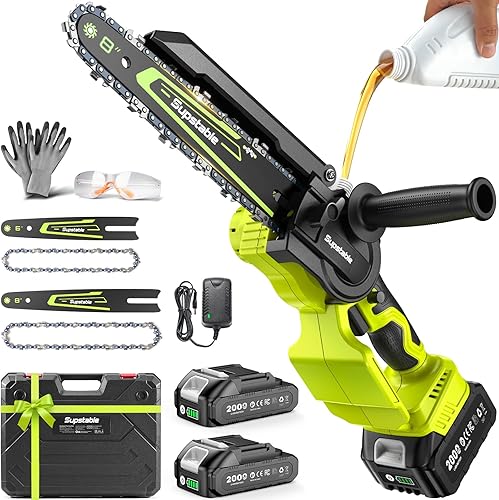 Best battery pick for light yard work
Supstable Mini Chainsaw Cordless
 Best simple battery saw for beginners
Tietoc Chainsaw 6 Inch Mini Electric Chainsaw
Battery vs gas chainsaw: which fits your yard?
A battery saw fits yard cleanup and light pruning; a gas saw fits firewood and tree work. Match the saw to the size of wood you cut most often, not to the biggest job you might face once a year.
A homeowner trimming hedges and branches all season gets more from a light battery saw. Someone with a wood stove or a few acres of trees needs the sustained power and refueling speed of gas.
Both types cut wood. The difference is how much weight you carry, how long the saw runs, and how much time you spend on fuel and engine care between uses.
Battery chainsaw vs gas chainsaw in one table
| Feature | Battery saws here | Gas saws here |
|---|---|---|
| Power source | Rechargeable battery | 2-cycle gas and oil mix |
| Weight | About 3.2 to 3.3 lb | 9.26 to 13.2 lb |
| Bar length | 6 and 8 in | 12 and 24 in |
| Run time | Up to 60 minutes per charge | Until the fuel tank empties |
| Start | Push a button | Pull start with choke |
| Upkeep | Charge, oil the chain | Fuel mix, air filter, spark plug |
The table shows the tradeoff plainly. Battery saws are light and easy to start, while gas saws run longer and cut larger wood.
How much does each saw weigh in your hands?
Battery saws are far lighter, so you can carry one all afternoon; gas saws put real weight in your arms. That weight difference matters most on ladders, in bushes and during long trimming sessions.
The Supstable mini saw weighs about 3.2 lb, and the Tietoc is close at 3.3 lb. Both are small saws you can hold at shoulder height without tiring quickly, but keep both hands on the saw even with these light battery models.
The VEVOR gas saw weighs 9.26 lb and the Husqvarna 460 Rancher weighs 13.2 lb. A 12-inch gas saw is already nearly three times the weight of a mini battery saw.
That gap changes how you work. A light battery saw suits repeated cuts at awkward angles.
A gas saw suits ground-level felling and bucking where you can rest its weight and let the engine do the work.
The gap is also bigger than the numbers suggest. Carrying 3 lb overhead and carrying 13 lb overhead for the same ten minutes are very different tasks for your shoulders.
A light saw lets you finish the row of shrubs instead of stopping halfway to rest your arms.
When weight decides the choice
Choose battery when your cutting happens above your waist or in tight spaces. Trimming a hedge line or thinning shrubs is tiring enough without holding a 13-pound engine.
Choose gas when you cut at ground level and can stand over the wood. The weight is easier to manage there, and the extra power pays you back in fewer stalls and faster cuts.
Battery chainsaw vs gas chainsaw for older users
A light battery saw is the easier choice for anyone who tires quickly or has limited grip strength. The Supstable and Tietoc saws both weigh about 3 lb and run without a pull cord.
Gas saws ask more of your arms and shoulders. Starting one takes a firm pull, and carrying a 9 to 13 lb saw for an hour is real work.
That is why the mini battery class exists at all: it removes the pull start and the engine weight from the job.
Which saw has the power you need?
Gas wins on raw power and bar length; battery wins on control and ease in small wood. For branches up to a few inches thick, a modern battery saw cuts cleanly without the fuss.
The Husqvarna 460 Rancher carries a 60.3-cc, 3.6-HP X-Torque engine and a 24-inch bar. That's a saw for felling trees and bucking trunks, not for trimming shrubs.
The VEVOR runs a 25.4CC 2-cycle engine on a 12-inch bar. Its cutting diameter reaches 9.84 inches, so it can take down small trees and cut firewood to stove length without the reach of the big Husqvarna.
The battery pair are smaller still. The Supstable's 1000W brushless motor drives a 6-inch or 8-inch bar at a chain speed of 32 ft/s, and the Tietoc's 880W motor spins a 6-inch chain at 28.6 ft/s.
Both cut branches and small firewood cleanly.
The practical line is the bar length. If the wood fits comfortably within a 6 to 8 inch bar, a battery saw handles it.
Once you're cutting trunks wider than 12 inches, gas is the right tool.
Battery chainsaw vs gas chainsaw for firewood
Gas is the better firewood saw when you buck logs all day. The Husqvarna's 24-inch bar reaches across a full trunk, and a fuel tank refills faster than a battery recharges.
A battery mini saw still earns a place at the woodpile. It's handy for cutting branches and kindling down to size without starting the big saw.
The Supstable's 8-inch bar is the one to fit for that work, while the 6-inch bar is better for limbing and shaping shrubs.
How long can you cut before stopping?
Gas runs as long as you keep refueling; battery run time is measured in minutes per charge. Plan around that difference before you buy.
The Supstable kit ships with two 2000mAh batteries and runs up to 60 minutes of continuous cutting. Its fast charger means you can rotate packs while you work.
The Tietoc has one 2000mAh battery. That's fine for a trim session around the yard, but a big cleanup may need a break while the pack recharges.
Its battery also has overload and temperature protection, which helps the pack last longer over the seasons.
Gas saws don't have that limit. The VEVOR's 0.24 qt fuel tank and its 0.17 qt chain oil tank let you cut for a long stretch between top-ups.
The Husqvarna's fuel system works the same way: stop, refuel and keep cutting. That matters when a tree is already down and you want it bucked before dark.
Plan your work around the power source
With a battery saw, cut the heaviest branches first while the pack is fresh. Save light trimming and cleanup for later in the charge.
Two packs in the Supstable kit make that easy, because one charges while the other cuts.
With a gas saw, fuel up before you start and keep a mixed can nearby. The extra minutes at the pump are the price of all-day cutting.
Which is easier to start and run?
Battery saws start with a button; gas saws need a choke and a pull cord, though modern models start more easily. Ease of starting is a real factor for occasional users.
The Supstable and Tietoc both start with a safety lock and trigger press. No choke, no cord and no fuel mix means the saw is ready in seconds.
The Supstable kit also includes gloves and goggles, so the safety gear comes with the saw.
Gas saws take more steps. The Husqvarna's Smart Start is designed to cut the effort of a pull start, and its combined choke and stop control reduces flooding risk.
The VEVOR uses an easy-start button and a brass carburetor for reliable starts, even in hot weather.
Neither gas saw starts as simply as a battery saw. If you only trim a few branches a month, the extra starting routine gets old fast.
A gas saw also needs a moment to warm up before you cut, while a battery saw is ready as soon as you press the trigger.
Noise and fumes near the house
A battery saw runs without exhaust and makes far less noise. That suits early-morning or evening trimming in a neighborhood.
Gas saws produce exhaust and engine noise. Run one outdoors with good ventilation and keep it away from windows and doorways.
If you need a saw close to the house, battery is the cleaner choice. The quieter motor also means you can hear a neighbor or a child approach, which matters when you work near a driveway or path.
Battery chainsaw vs gas chainsaw for a first saw
A battery saw is the easier first chainsaw. The button start, light weight and simple chain oiling remove most of the intimidation.
A gas saw as a first saw makes sense only when your main job is firewood or tree work. Even then, practice the start routine and read the manual before cutting.
What upkeep does each power source need?
A battery saw needs a charge, clean bar oil and a sharp chain; a gas saw adds fuel mixing, filters and spark plugs. The upkeep gap grows the less often you cut.
For battery saws, fill the bar oil tank and keep the chain sharp. The Supstable and Tietoc both have auto oilers.
The Supstable's 30ml tank takes oil and a press of the bulb sends it to the chain, so you fill once and cut without hand oiling.
Gas saws add a 2-cycle fuel mix. The VEVOR and Husqvarna both run on gas mixed with 2-stroke oil.
You'll also keep an eye on the air filter, spark plug and carburetor over the seasons.
The Husqvarna adds an Air Injection system that clears larger dust and debris before it reaches the filter. That helps engine life but doesn't remove the need for routine checks.
The VEVOR adds tool-free chain tensioning, so tightening the chain takes a turn of a knob rather than a wrench.
What comes in each kit
The Supstable kit is the most complete of the four. It includes the saw, a carry case, two batteries and a charger, two chains, a 6-inch and an 8-inch guide plate, two guide plate sheaths, gloves, goggles and a screwdriver.
One note: the kit includes a small oil bottle but does not include lubricating oil, so buy bar oil before the first cut.
The Tietoc kit is simpler: the saw, one battery, a charger, two chains, a guide plate, a sheath and a screwdriver. It ships in a paper box, not a hard case.
The VEVOR and Husqvarna are gas saws that arrive with their own bars, chains and tool kits for setup and refueling.
Storing each saw between jobs
Store a battery saw with the battery removed and kept at a moderate temperature. Empty the oil tank if it will sit for months, and keep the bar covered.
The Supstable's case makes this easy, since the bar sheaths and tools fit inside.
Store a gas saw with the fuel system handled as its manual directs. Old fuel mix is a common cause of hard starting, so don't leave a full tank sitting all winter.
Keep the air filter clean before you put it away and the saw will start easier next season.
Which saw fits your yard?
Choose the Supstable mini battery saw for most yards and the Husqvarna 460 Rancher for serious tree work. The two gas saws sit in between for buyers who want fuel power in a smaller package.
If your work is branches, hedges, small trees and light firewood, go battery. The Supstable's two batteries and two bar sizes cover the widest range of light jobs, and its 3.2 lb weight keeps long sessions comfortable.
Its 1000W brushless motor also gives it the most power of the two battery saws here.
If you want the simplest starter battery saw, the Tietoc is the pick. Its single battery and 6-inch bar suit trimming and small wood, and the auto oiler keeps the chain ready.
The Tietoc kit has less in the box than the Supstable, though its single battery means shorter sessions before a recharge.
If you want fuel power without a big saw, the VEVOR is the middle step. Its 12-inch bar and top handle suit limbing and light felling where a battery saw runs out of reach.
It weighs 9.26 lb, still less than the Husqvarna, and its 1.2 HP engine is enough for small trunks and firewood.
If you cut firewood or fell larger trees, the Husqvarna 460 Rancher is the heavy-duty choice. Its 24-inch bar and 3.6-HP engine handle trunks a mini saw can't touch.
It also carries an inertia-activated chain brake and LowVib handles, features aimed at long cutting days.
Battery chainsaw vs gas chainsaw: the final call
Buy battery if your cutting stays in branches and small wood and you value quiet, light and simple starts. Buy gas if your yard includes firewood, larger trunks or long cutting days.
Our Stihl vs Husqvarna chainsaw comparison helps if you're leaning toward a gas saw and comparing brands. For battery buyers weighing brands, the chainsaw brand guide covers who makes what.
If Echo is on your list too, the Echo vs Husqvarna chainsaw breakdown covers how the two lines differ. And if the Husqvarna 460 Rancher is your leading gas pick, read the Husqvarna 455 Rancher review to see how the smaller sibling compares before you decide.
Our score weighs specs, features and buyer feedback against what you're shopping for.
Frequently asked questions
Is a battery chainsaw strong enough to cut down a tree?
A battery chainsaw handles branches, limbs and small trunks, but it isn't the tool for felling a mature tree. A 6-inch or 8-inch battery bar cuts limbs and firewood pieces; for a trunk wider than its bar, step up to a gas saw with more power and reach.
How long does a battery chainsaw run on one charge?
It depends on the battery and the work. The Supstable kit runs up to 60 minutes of continuous cutting with its two 2000mAh batteries, and the Tietoc has a single 2000mAh pack.
Thick wood drains a battery faster than light trimming, so a spare helps on bigger jobs.
Do gas chainsaws need more maintenance than battery saws?
Yes. A gas saw needs a fuel and oil mix, a clean air filter, a spark plug check and carburetor care over time.
A battery saw needs a charged battery, a clean bar and chain oil in the tank, so it's the lower-upkeep choice for casual trimming.
Can I use a gas chainsaw indoors or near my house?
No. A gas chainsaw makes exhaust fumes and needs outdoor ventilation, and its engine noise is much louder than a battery saw.
A battery saw runs without exhaust and is far quieter, which suits work close to the house or in a neighborhood.
Which is better for a first chainsaw?
A battery saw is the better first chainsaw for most homeowners. It starts with a button, needs no fuel mixing, weighs less and handles typical branch trimming; a gas saw makes more sense as a first saw only when your main work is firewood or bigger trees.


